Get Full Government Meeting Transcripts, Videos, & Alerts Forever!
Get email alerts on the Charter Amendments topic
No spam. Unsubscribe anytime.
Council refers six charter amendments — including signature threshold increase — to Nov. 3 special election after extended debate
Summary
The council voted to send a package of six proposed Home‑Rule Charter amendments to a special coordinated mail‑ballot election on Nov. 3, 2026. The measures include expanding permitted executive‑session topics for boards and commissions, changing when elected officials take office, raising initiative/referendum signature thresholds (initiative 5%→7.5%, referendum 2.5%→5%), allowing meeting locations outside city‑owned buildings if accessible, adding a staff review/comment meeting for proposed initiatives, and terminology updates.
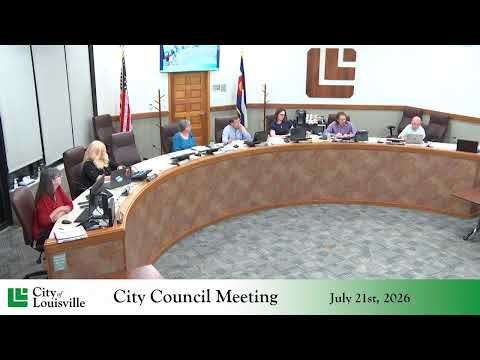
Council considered six proposed amendments to the Louisville Home‑Rule Charter and voted July 21 to refer them for voter consideration at a coordinated mail‑ballot special election on Nov. 3, 2026.
Staff overview: City clerk Jenny Klein (speaker 3) summarized the package and timeline, and recommended prioritizing executive‑session topic expansion, timing of taking office, and signature threshold changes. The city attorney (speaker 11) advised the council on legal constraints and noted procedural options such as implementing aspects by ordinance where appropriate.
Key measures and debate:
- Executive‑session topics (Ordinance 19‑29): The proposed amendment would expand the topics boards and commissions may discuss in executive session consistent with state open‑meetings law. Proponents on council argued private legal advice and confidential land‑acquisition discussions sometimes require executive session; public commenters urged caution and called for clearer limits. Council passed the ordinance on second reading with the 2nd‑reading amendments.
- Taking office timing (Ordinance 19‑30): The charter would be amended so the mayor and councilmembers take office at the first meeting after election certification rather than immediately after election; council approved the amendment.
- Initiative/referendum signature thresholds (Ordinance 19‑31): Staff proposed raising thresholds from 5% to 7.5% for initiatives and 2.5% to 5% for referendums. The item produced lengthy public comment and debate: opponents said the change would raise barriers to direct democracy and could be perceived as restricting ballot access; supporters cited recent controversial initiatives and recommended an incremental increase to require broader support before placement on the ballot. Council voted to refer the change to voters; roll call recorded a 6–1 vote with one member opposed.
- Meeting locations (Ordinance 19‑32): Council approved allowing public bodies to meet in accessible locations other than city‑owned public buildings, subject to accessibility rules and council action.
- Review/comment meeting for initiatives (Ordinance 19‑33): The charter would require proponents to attend a public review/comment meeting with staff within 10 business days of submitting draft text so staff can provide nonbinding feedback. Some residents argued the requirement could delay filing or chill proposers; staff and some councilmembers said early feedback could prevent later form‑of‑text rejections and save time. Council approved referral to the ballot.
- Terminology update (Ordinance 19‑34): Several charter edits would replace the word "citizen" with "member of the public" or "resident" where appropriate to reflect public records access and inclusivity. Public comment urged preserving the word "citizen" in some contexts; council approved the revision.
After votes on the package, council adopted Resolution 65 to call the Nov. 3 coordinated mail special election that will include these charter questions and the historic‑preservation tax extension.