Get Full Government Meeting Transcripts, Videos, & Alerts Forever!
Get email alerts on the Property Taxes topic
No spam. Unsubscribe anytime.
Tax assessor explains rates, council hears impact of new value and BPP exemption
Summary
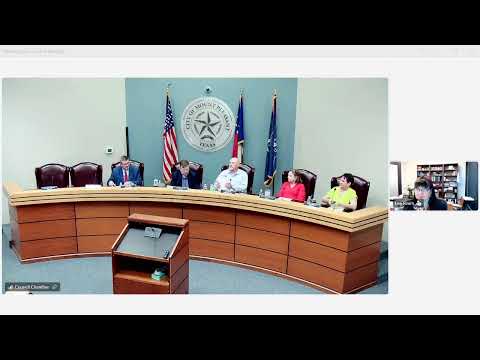
At a July 21 workshop the local tax assessor walked the council through five years of tax-rate history and definitions (no-new-revenue, voter-approval, unused increment, de minimis) and said uncertified new taxable value of roughly $50 million would add revenue while a $42 million reduction from the new business personal property exemption offsets some of that gain.
The city’s tax assessor briefed the council on July 21 on how property-tax rates interact with changes in taxable value and showed five years of rate and value history.
The assessor walked through three key charts: a tax-rate history comparing the no-new-revenue, voter-approval and adopted rates; a five-year history of taxable values; and on-time tax-collection percentages. She explained that the no-new-revenue rate is calculated to produce roughly the same revenue for the taxing unit as the previous year, the voter-approval rate is the ceiling a taxing unit may adopt without triggering an election, and that an unused increment rate allows the taxing unit to “bank” incremental voter-approval room for up to three years.
During follow-up questions, city officials asked for an elementary example to make the mechanics clear for residents. The assessor said that, if the council adopts the no-new-revenue rate, an individual homeowner’s tax liability would generally be about the same as the prior year absent a major event that changes taxable property. She added that new taxable value is additive: the city would keep prior-year revenue (by adopting the no-new-revenue rate) and collect taxes on newly added value.
The assessor gave two concrete figures discussed during the workshop: an uncertified estimate of about $50,000,000 in new taxable value this year and an estimated $42,000,000 reduction in taxable value attributed to the new business-personal-property (BPP) exemption that took effect this year. She cautioned the council that those values were not yet certified. The assessor also described the state’s property-value-study process and the role of the PTAD division of the comptroller’s office in auditing local appraisals.
The presentation concluded with an explanation of collection timing and exemptions (quarterly payments for residents over 65, deferrals, late payers) and an offer to make the supporting materials available online for public inspection.
The council did not take any formal vote on rates at this meeting; the assessor’s information was presented as background for upcoming budget decisions.