Get Full Government Meeting Transcripts, Videos, & Alerts Forever!
Get email alerts on the Floodplain Regulations topic
No spam. Unsubscribe anytime.
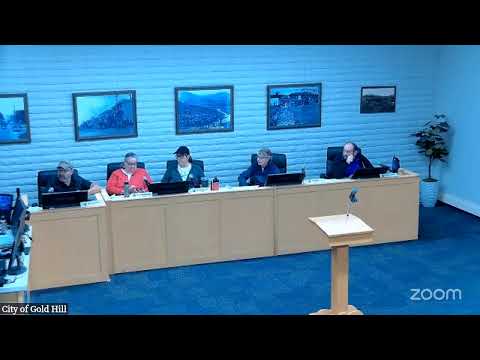
Gold Hill council hears contentious first reading of floodplain ordinance tied to FEMA rules
Summary
At a Dec. 3 hearing, planners told the Gold Hill City Council that adopting FEMA'aligned floodplain rules would require "no net loss" mitigation, a 170-foot riparian buffer inside special flood hazard areas and tree-replacement ratios; residents warned the rules could limit private riverfront use and property resale. Second reading set for January.
Gold Hill ' At a Dec. 3 public hearing, the City of Gold Hill discussed a proposed rewrite of chapter 15.12 of its municipal code to meet new National Flood Insurance Program (NFIP) and federal Endangered Species Act-related standards recommended by FEMA.
Rowan Fairfield, a land-use planner with the Rogue Basin Council of Governments (RBCOG), told the council the changes stem from a 2016 biological opinion and subsequent FEMA implementation guidance. "FEMA gave us three options," he said, adding that staff used the agency's model ordinance because "the model code is the least bad of the three options that FEMA gave us." Fairfield outlined three "floodplain functions" the draft rules aim to preserve: floodplain storage, water quality and riparian vegetation. He described "no net loss" performance standards tied to simple proxies, such as limiting impervious surface, requiring engineered or low-impact stormwater treatment and replacing vegetation removed during development.
Staff estimated about 70 tax lots touch Gold Hill's mapped floodplain; of those, 20 are unimproved and 14 are both unimproved and under 5,000 square feet, which staff said could face the greatest development constraints. Fairfield also described the draft's riparian-buffer approach: the ordinance would treat the riparian buffer as the portion of the special flood hazard area within about 170 feet of the river and require a "beneficial gain" planting standard for projects in that zone. "They came up with a 170 feet by taking an average tree in Oregon and measuring how much shade it produces on average," Fairfield said. He explained tree-replacement ratios would typically be two-to-one and could be higher for mature trees.
Public testimony was strongly skeptical. Linda Murata urged the council not to approve rules that she said would push vegetation and buffers "up to our back doors," limiting ordinary activities such as decks, gardens and river access. "I really, really beg you folks not to impose this upon us," Murata said. Another longtime resident, Linda Walker Turner, said she had lived through large floods and questioned whether endangered-species protections should override local considerations. Tim Lopez called the measures "unconstitutional" and suggested legal challenges could be mobilized.
Councilors asked staff how the city would be affected if it did not adopt the model code. Staff said FEMA had asked communities to choose a compliance path by Dec. 1; if a jurisdiction did not make a choice, the default could be a permit-by-permit approach that places greater burdens on applicants and staff. Staff told the council it had notified FEMA of the city's ongoing public process and recommended scheduling a second reading in January to allow more review and legal consultation.
The hearing closed with staff reiterating the unresolved legal questions about how the FEMA-preferred language fits within Oregon land-use law. The council set the ordinance for a January second reading and directed staff to continue outreach and to report back with any legal guidance.
What happens next: The council will hear a staff report, take additional public testimony if needed and consider the ordinance in January for a second reading and potential adoption.