Get Full Government Meeting Transcripts, Videos, & Alerts Forever!
Get email alerts on the Municipal Resolution Bill Of Rights topic
No spam. Unsubscribe anytime.
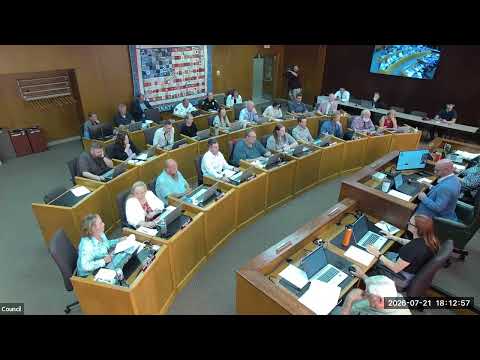
Green Bay council adopts nonbinding ‘economic and social bill of rights’ after hours of testi mony and split debate
Summary
The Green Bay Common Council voted 9–3 July 21 to adopt a nonbinding municipal resolution framing an economic and social ‘bill of rights’ as a city vision. Supporters said the statement will guide future policies; opponents said it lacks funding, measurable targets and exceeds municipal authority under state law.
The Green Bay Common Council voted 9–3 on July 21 to adopt a nonbinding resolution that the sponsors described as an economic and social "bill of rights" intended to guide city priorities.
Alder Shelton, who introduced the resolution as a 250th‑anniversary vision statement, said the document sets a public standard for decisions on housing, parks, climate mitigation and access to services, even where state law limits the city’s direct authority. "What this really does is it makes real those commitments that we have," Shelton said during introductory remarks. Shelton noted the resolution is not a binding program but a framework for future deliberations.
The council opened the floor for public testimony and heard more than a dozen speakers on both sides. Sarah Bashey, who identified herself as a resident and registered to speak, said she supported the resolution because "these are all human rights and we are all people and deserving of them." Harvey Kaye, a retired UW‑Green Bay professor, framed the resolution in a long historical context of an economic bill of rights and urged passage. Amber Edwards, representing the City of Green Bay Equal Rights Commission, spoke in support and asked the council to "work together with integrity and bipartisan conversation to reach a level of accountability and compromise." State Representative Ahmad Rivera Wagner said he would work with the council to pursue policy that flows from the statement.
Opponents cautioned that the document lacks an implementation plan, funding sources and measurable outcomes. One council member urged a "no" vote, saying the resolution "contains no implementation plan. It identifies no funding source, no budget, no timeline, and no measurable outcomes," and cited Wisconsin statutes that preempt municipal authority on certain matters. During debate a council member explicitly cited Wisconsin Stat. §104.001 and §66.1015 when discussing limits on municipal minimum‑wage or rent control authority.
Supporters responded that the resolution is a set of guiding principles rather than a promise to immediately deliver specific benefits. "This is a vision," a sponsor said, urging the council to use the resolution to guide later policy choices, lobbying and committee work. Council members also discussed whether the resolution would provide residents with an accountability tool even where legal preemptions exist.
After deliberation the council approved the resolution by roll call: nine in favor, three opposed. The mayor noted the resolution is nonbinding and that subsequent policy changes or programs would require separate actions, funding and review.
The council recorded that the item will be used as a guiding framework going forward; no specific implementation steps or budget allocations were adopted with the resolution. Next steps for the council include committee follow‑ups and potential requests for staff reports on how the guiding language might inform particular programs.