Get Full Government Meeting Transcripts, Videos, & Alerts Forever!
Get email alerts on the Alleys topic
No spam. Unsubscribe anytime.
Mitchell council tables two alley assessments, debates funding and long-term policy
Summary
After a full public hearing and hours of testimony, Mitchell city council tabled assessments for two alley blocks, denied several others and directed staff to return with a cost‑share proposal for hard‑surfacing; residents voiced both strong support and opposition, citing drainage, access and fairness for owners who previously paid assessments.
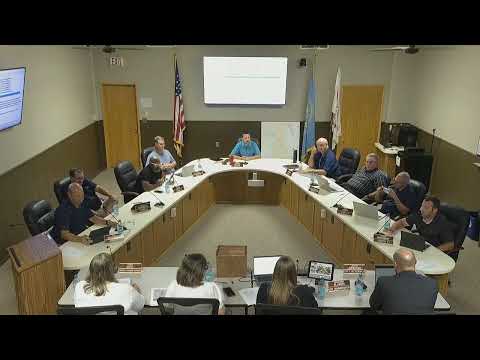
Mitchell’s city council spent the bulk of its meeting debating whether to convert eight gravel or asphalt alleys to 6‑inch concrete and how much the city should pay if property owners ask to hard‑surface their alleys.
The hearing opened with staff describing options—100% owner assessment, a shared cost, full city funding, increased maintenance or doing nothing—and reporting that the city’s alley fund currently holds about $326,000 with roughly $70,000 expected next year. Engineer Joelle Damon and public works staff detailed the scope of proposed work (removal of existing surfacing, subbase, engineering fees, curb/tie‑ins where needed) and the tentative schedule (bidding in 2027, construction the following summer, assessments placed on tax rolls with up to a 10‑year repay plan at 8% interest).
Residents appeared at the podium to make opposite cases. Josh Peterson (speaker 26), who lives on the 300 block of East 1st, said his neighborhood had collected signatures and “we have 7 that are absolutely on board,” arguing the alley has long caused drainage and maintenance problems. Carol Torberson (speaker 13), who said she has pushed for improvements for 10 years, said ad‑hoc gravel work washes away after storms. Opponents questioned fairness: one resident who said he already paid an earlier assessment for asphalt asked whether property owners would be charged again if the city required concrete and urged council to deny assessments rather than place the burden back on renters.
Council members repeatedly pressed staff on mechanics and fairness. A council member asked whether utilities had been contacted about burying lines under 6 inches of concrete; staff said utilities would be notified and coordinated during final design if a project is approved. Council members also debated whether alleys adjacent to downtown Main Street are a different class of project because they serve more public traffic and events.
On individual blocks the council took separate votes rather than approve the list wholesale. The council voted to table item 1 (300 block of East 1st) after proponents presented evidence of majority support and asked for additional signatures and documentation; the council instructed staff to list the documentation and bring the item back. Several other blocks were denied after no supporters appeared at the podium. The council explicitly tabled the 400 block of East 7th as well; those two items were starred for follow‑up and staff were assigned to return with a path forward.
Mayor/Chair (speaker 2) summarized the near‑term direction: the council asked staff to return with options for a fair cost‑share policy (examples discussed included 80/20 and others), an accounting of annual revenues available from the landfill‑fee alley fund, and an implementation plan that separates downtown/Main Street alley priorities from residential alley maintenance. Several council members signaled they prefer prioritizing maintenance of the worst alleys and considering partial subsidies rather than full city funding, noting that at current revenue levels full city funding would cover roughly one alley per year.
What’s next: Council tabling means proponents can document neighborhood majority support and return an item to a future agenda; staff will present proposed cost‑share scenarios and an updated maintenance plan for council consideration before the city commits to further assessments or full funding.