Get Full Government Meeting Transcripts, Videos, & Alerts Forever!
Get email alerts on the Municipal Debt topic
No spam. Unsubscribe anytime.
City staff outlines El Dorado’s $23.79 million municipal debt and $39.8 million Army Corps obligation
Summary
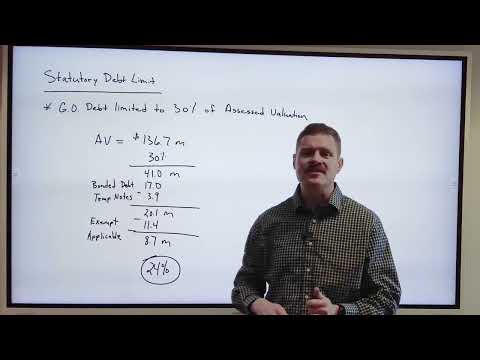
A city staff member explained El Dorado’s 2024 municipal-debt profile, listing $23,790,000 in city debt (about $1,962 per resident) and a separate $39,800,000 obligation to the U.S. Army Corps of Engineers; the presentation showed the city was using roughly 24% of its 30% statutory debt limit.
A city staff member in El Dorado walked residents through the municipality’s outstanding debt and borrowing options in an informational video, saying the city carried about $23,790,000 in municipal debt in 2024 and a separate $39,800,000 obligation to the U.S. Army Corps of Engineers.
The presenter explained the main types of municipal financing the city can use — general obligation bonds, revenue bonds, revolving loan funds, temporary notes, leases and purchase agreements — and why the city chooses one instrument over another. "General obligation means that the city is guaranteeing the bonds and its debt service payments with the full faith and credit of the city," the staff member said, noting GO bonds typically command lower interest rates.
Why it matters: The mix of instruments affects the city’s borrowing cost and which debts count against the state-law limit. Using the 2024 assessed valuation of $136,700,000, the presenter showed the 30% statutory cap equals $41,000,000. After subtracting $17,000,000 in GO bonded indebtedness and nearly $4,000,000 in temporary notes, the city calculated $20,100,000 of capacity remaining; subtracting $11,400,000 of exempt debt yielded $8,700,000 of debt that counts against the statutory limit — about 24% of the $41,000,000 cap.
Key figures and definitions came from the video: the presenter said a 10-year municipal bond rate currently costs the city about 3.5% interest, and described revenue bonds as being backed by utility revenues (water or sewer) rather than the city’s full faith and credit, which typically leads to higher interest rates but can be useful for utility projects. He described state revolving loan funds as an additional option and cited a Kansas Department of Health and Environment program the city has used for water and sewer projects.
The presenter gave a line-item balance for 2024: "a little over $17,000,000 outstanding in general obligation debt," about $1,300,000 in revolving loan funds, almost $4,000,000 in temporary notes (to be rolled into longer-term GO bonds once projects complete), $1,500,000 in leases and roughly $140,000 in purchase agreements, totaling $23,790,000 (about $1,962 per resident). The city official emphasized that some debt types — for example, utility-backed debt and debt backed by special assessments — are exempt from the statutory debt-limit calculation.
The video also reviewed the city’s contract with the U.S. Army Corps of Engineers related to El Dorado Lake. The presenter said the contract began in 1972 with initial construction costs of $22,900,000 and that interest had compounded annually; terms were restructured in 2022 so the outstanding balance is now $39,800,000 and interest accrues on a simple-interest basis rather than compounding. "On its full amortization schedule, that number would have originally cost the city upwards of $400,000,000 by 2081," the staff member said, and added restructuring will limit the city’s exposure (the presenter said the liability is now capped at about $55,000,000). The presenter reiterated that the Army Corps obligation is federal and does not count against the city’s statutory debt limit.
The presenter noted how costs are allocated for projects: debt for new development often gets paid by developers or buyers via special assessments, while capital projects that benefit adjacent residents include special assessments for those properties and a citywide share covered through property-tax-funded portions. The video clarified that the city commission generally can authorize issuance of debt without a public vote, with some exceptions.
No formal votes, motions or policy actions were taken in the video; it was an explanatory presentation. The presenter closed by saying the city continually reviews its debt portfolio and will refinance when it reduces costs for taxpayers.
Ending: The video offered residents a numerical snapshot of El Dorado’s debt profile, the statutory-limit calculation and the special case of the long-running Army Corps obligation; no policy decision or vote was recorded in the presentation.