Get Full Government Meeting Transcripts, Videos, & Alerts Forever!
Get email alerts on the Mobile Food Vendors topic
No spam. Unsubscribe anytime.
Edwardsville City weighs new rules for mobile food vendors, including movement limits and fees
Summary
Council heard public comment and staff explanations of a draft ordinance that would regulate mobile food vendors by zoning restrictions, a movement requirement (no permanent parking; three consecutive days at a location then move), and a fee structure including a $250 annual business-license option or daily permits; staff said parks would be excluded unless city‑sponsored events.
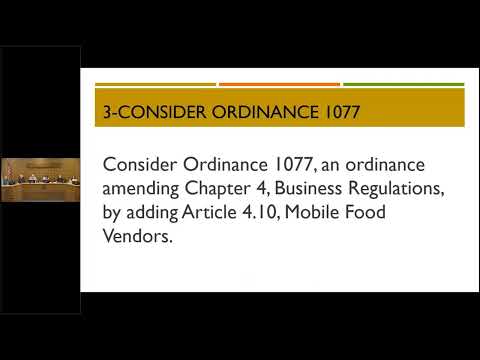
Roscoe Davis presented background on a proposed mobile food vendor ordinance that staff described as intended to protect public health, safety and fair competition while preserving limited public‑space uses. He told the council the draft (referred to as ordinance 10 77 in staff materials) would exclude city parks from a public‑property prohibition so vendors could be permitted for single‑day events in parks or city‑sponsored gatherings.
The measure would also apply zoning limits to certain residential districts, the presenter said, noting the building where the meeting was held is in an R‑2 district and that the ordinance would add allowances for mobile vendors on private property in those zones. "Public property as we defined it here excludes the park and recreational places such as Riverview Park," Roscoe Davis said.
Staff described operational rules in the draft: vendors could not permanently park at a single location, a unit could operate up to three consecutive days at one address and then would be required to move, and vendors could apply for either an annual permit or day permits. Under the framework discussed, an annual business license approach would cost $250 and allow repeated appearances (staff described an annual option that covers up to a specified number of days), while the per‑day permit option would be a lower daily fee (staff cited $25 per day in examples) and an inspection/permitting charge of about $50 for a three‑day continuous stay. Staff and a commenter also described existing state inspection and licensing requirements that vendors must meet.
Council members pressed staff on the ordinance's distance restrictions from brick‑and‑mortar restaurants. The draft included a 150‑foot radius from restaurants in one section; staff said a larger buffer (up to 500 feet) had been suggested but could create enforcement challenges where restaurants cluster. "That 150 feet is not comfortable; we can certainly change that with any motion you make," the presenter said when discussing options.
A public speaker who identified his affiliation as Roscoe's Barbecue urged the council to allow flexibility so vendors could operate on private lots that serve residents or employees (for example, an assisted‑living parking lot) and asked for discretion to permit vendors that serve such populations. City staff said permits would generally require paved surfaces unless part of a city‑approved event, but they also said permitting discretion could allow gravel or similar sites in some cases.
Staff emphasized the ordinance is intended to regulate operations and safety (inspections by the fire marshal were noted) rather than to ban vending outright, and they described the intention to calibrate fees so the licensing scheme is not punitive. The council did not adopt the ordinance in the provided transcript and no formal vote on the draft was recorded in these segments. Staff said they would refine the language and return with further details.
The council asked staff to provide clearer language on zoning exclusions, the radius from restaurants, and enforcement mechanics before pursuing final action.