Get Full Government Meeting Transcripts, Videos, & Alerts Forever!
Get email alerts on the Early Childhood Education topic
No spam. Unsubscribe anytime.
Reserve choices and recession risk could push Multnomah County’s Preschool for All fund into deficit, staff analysis shows
Summary
County budget staff told the Multnomah County Board of Commissioners that updated economic models show Preschool for All can be implemented under baseline and TAG-recommended scenarios, but increasing reserves to one or two years of operating costs or modeling a steep recession could drive the fund into deficit; commissioners asked for spreadsheets and scheduled a follow-up work session.
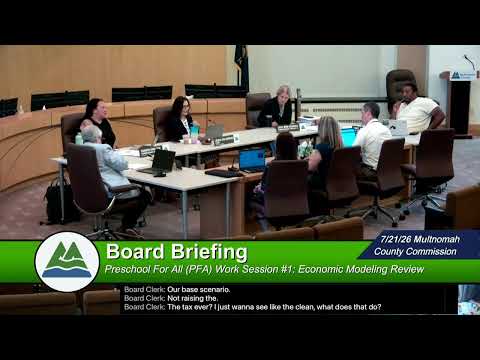
At a Multnomah County Board of Commissioners briefing, county budget staff presented updated economic models for Preschool for All showing the program remains funded under several baseline and TAG-recommended scenarios but is sensitive to reserve-policy choices and a modeled sharp recession.
Jeff Renfro of the county budget office told commissioners the baseline model incorporates the FY27 adopted Preschool for All budget and a preliminary population forecast from Portland State University. "We are comfortably above the zero axis, which means that we would successfully implement the program as planned," Renfro said, summarizing the baseline results.
The modeling shows different population assumptions change estimated seat needs: the baseline and low forecasts imply just above about 8,000 seats at universal enrollment, while the high-population scenario would require roughly 11,200 seats. Renfro said the blue line on the presentation reflects PSU’s official, most likely forecast and that the high estimate assumes a stronger recovery in birth rates.
Renfro also ran the TAG-recommended scenario, which incorporates a two-year delay in the tax increase and updated seat costs from a recent true-cost study. "Even with the lower population, the two-year delay and updated costs, the fund balance still bottoms out at around $250 million in our baseline scenario," he said.
Commissioner-requested scenarios produced more divergent outcomes. A scenario requested by one commissioner assumes higher participation (90 percent for 3‑ and 4‑year‑olds), no 10 percent attrition of children before pre‑K, higher professional‑development and inclusion costs, and a much larger reserve. Renfro said modeling a reserve equal to one year of operating costs would require transferring roughly $400 million into reserves in early years and, when combined with a modeled one‑year, 40 percent revenue hit (a simulated great‑recession scenario), the forecast falls well below zero.
"By changing the reserve rule and transferring what's in the fund balance to the reserve, we're taking what we had intended to spend on future programmatic expenses and locking it in our reserve," Renfro said, explaining why the one‑year and two‑year reserve scenarios push the fund into deficit; a two‑year reserve scenario produced an early reserve level of about $800 million in the model and did not recover.
Another commissioner’s scenario tested indexing without rebasing and a modest family cost share for households above a self‑sufficiency threshold. Renfro said that approach — modeled as self‑attestation with no income verification and about 15 FTE for administration — produced a net revenue gain of roughly $6 million per year after administration costs. Denise McLean, director of the Preschool and Early Learning division, noted PSU’s final demographic report is expected in mid‑August and that assumptions around thresholds had been updated in staff materials.
Rachel Pearl, director of the Department of County Human Services, cautioned that collection of family payments could impose administrative burdens on providers and the county, and that the mechanics of who collects those payments affect provider participation and family continuity of care. Mary King, an economist and TAG member, told the board she remembers TAG’s work did not include administrative‑cost estimates for means‑testing nor estimates of participation impacts tied to verification burdens.
Board members spent time on reserve policy trade‑offs: higher reserves buy time to avoid midyear cuts but require moving programmatic fund balance into reserves, reducing the county’s ability to offset future deficits. Several commissioners said they want a more detailed planning scenario showing what program adjustments would look like if a recession occurred mid‑year.
Renfro said staff will share the underlying spreadsheets and appendices requested by commissioners and noted a follow‑up work session is available; the board confirmed a next meeting on 07/23/2026 at 9:30 a.m. to continue deliberations.
The briefing did not include formal motions or votes. Staff flagged that the PSU population inputs are preliminary and that administrative‑cost assumptions, verification mechanics and political impacts of means‑testing remain policy choices that could materially change the fund outlook.