Get Full Government Meeting Transcripts, Videos, & Alerts Forever!
Get email alerts on the Homestead Tax Credit topic
No spam. Unsubscribe anytime.
Platte County adopts procedures to implement state homestead property tax credit
Summary
Platte County commissioners voted unanimously to adopt county procedures to identify eligible homestead properties and start the homestead property tax credit program after voters approved the state law; staff identified about 20,341 likely eligible parcels and will publish a searchable map and appeals process. The commission noted a software vendor issue in the county collector's office and urged workarounds to meet statutory timelines.
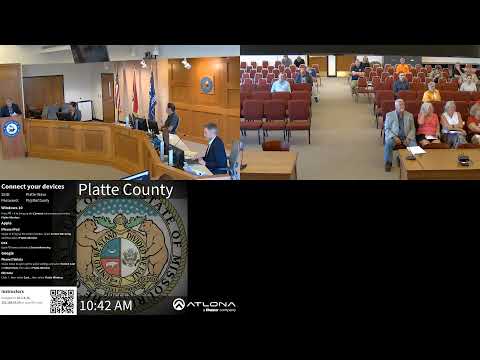
The Platte County Commission on Monday adopted an order setting the county's procedures to implement the state homestead property tax credit following voter approval of the measure.
County administrator Wes Minder told commissioners staff screened assessor data to identify approximately 20,341 likely eligible homestead parcels out of roughly 34,580 residential properties. Minder said staff used mailing-address matching, excluded LLCs and incorporated-business ownerships, and cross-checked short-term rental lists to reduce administrative overhead and produce an initial list for the program. He said staff will publish a searchable map by address, provide a contact form for opt-outs and appeals, and run a short demonstration at the next commission session.
"We will have a web page that will have that public facing map," Minder said, adding residents who believe they were screened out can appeal to have their parcel reviewed.
Commissioner (speaker) framed the measure as a taxpayer protection, praising staff work and the county board that will administer grants next year: "This is a great day for Platte County homeowners," the commissioner said. He noted the legal duty to apply the credit and urged the county collector's office to implement it without delay.
The commission also addressed a software issue raised in public comments and during the meeting. The commissioner said the county collector learned on April 22 that the collector's software provider "was not going to apply this tax credit," and commissioners and public speakers pressed staff and vendors for workarounds so credits could be applied this year rather than delayed until 2027.
Several members of the public spoke during the comment period. Jim Bosch, a candidate for county collector, urged officials to find technical workarounds and implement the credit this year rather than postpone it, saying that issuing credits after the fact could create budget and liability issues. Mary Calvillo, a candidate for county clerk, pressed commissioners on transparency around records requests and warned that perceived delays can erode public trust. Former commissioner John Elliott described large assessment increases reported in his neighborhood and urged swift implementation so eligible taxpayers do not face large tax bills this fall.
The commission approved the order determining eligible homesteads and adopting county procedures by vote, recorded as unanimous 3-0. The order directs staff to publish the listing and web map, run a public demonstration, and provide an appeals process. Minder said staff expects the map and demo to be available by the end of the month.
Implementation details in the adopted order include an initial screening methodology (mailing-address match, exclusion of LLC/incorporated ownership and short-term rentals, inclusion of trusts when addresses match) and a plan to reconcile and clean assessor data for edge cases (for example, nonstandard address formats around lake properties). The order also notes that the county governing body may adopt reasonable procedures to carry out the statute.
Next steps: staff will post the searchable map and contact form, present a system demo at the next commission session and work with the county collector and the vendor to ensure the credit appears on tax statements as required by state statute.