Get Full Government Meeting Transcripts, Videos, & Alerts Forever!
Get email alerts on the Local Taxation topic
No spam. Unsubscribe anytime.
Lorain County commissioners hear mixed public reaction to proposed jail sales tax
Summary
At a July 21 public hearing, Lorain County officials outlined two 0.25%-point, 15-year sales-tax options to fund replacement and repairs of the county jail and detention home. Residents expressed both support for new facilities and skepticism about trust, transparency and local hiring.
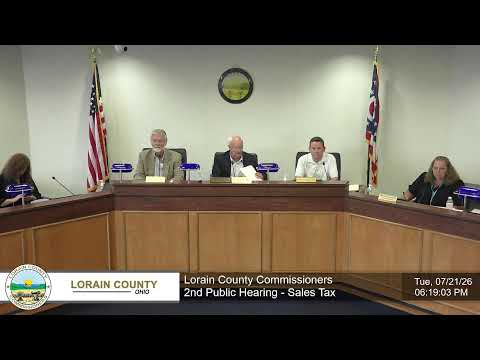
Lorain County commissioners on July 21 heard more than two hours of public comment on a proposal to add 0.25 percentage points to the county sales tax for 15 years to fund a new jail and detention facility and related criminal-justice expenses. Commissioners said the tax would generate roughly $14 million a year under current collections and would be used to bond and build a new 540-bed jail the sheriff requested; proponents said the current jail is unsafe and undersized, while opponents said the measure would burden residents on fixed incomes and that past transfers of jail funds have eroded trust.
The hearing centered on two possible ballot wordings the board is considering: a broader measure that would dedicate funds to “criminal justice and administrative services” (giving officials flexibility on how to use excess revenue) and a narrower measure limited to “construction, equipping or repair” of specific jail and detention facilities. Chair (speaker 2) described both options and said only one would be placed on the agenda for a final decision; the board discussed scheduling the item for its July 28 meeting, with July 31 as a backup before the statutory deadline.
Why it matters: Commissioners and local judges said the county’s jail system is aging and over capacity. Lisa Bizitzovich, civil administrator for Judge Cook, told the hearing that the current facility “is out of code and dangerous to both the jail staff, corrections officers, and inmates” and that a new facility would increase safety and give judges more options. Judge Swinski said the detention home (built in 1959) has mold and HVAC problems and urged, “Please allow them to put it on the ballot and allow us to vote for it.”
Opponents and skeptics focused on cost, fairness and trust. Linda Heck of Elyria asked, “Why don't the people there using the facility pay for it?” and said an added tax would strain families on fixed incomes. Several speakers noted a previously set-aside $20 million jail fund that was later moved into the general fund, which they said contributed to public distrust. Leslie Mingus said that prior large projects and perceived closed-door decisions — including sewer and economic-development work — had left residents wary of another county tax request.
Details and fiscal context: Commissioners and staff provided preliminary fiscal estimates and program context. Chair (speaker 2) said a 0.25% increase currently would produce roughly $14 million a year and that early planning estimates put the new jail at about $145 million, with construction requiring bonding over the 15-year sunset of the tax. Officials said a construction manager at-risk and an architect have already been retained and that the county has spent roughly $3 million on consultants, architects and construction management to date; a resident asked for an itemized breakdown, which the commissioners said is available via public records requests.
Local hiring and procurement were frequent topics. Construction-industry speaker Brian Baker urged the county to maximize use of local trades and asked how local subcontractors would be ensured work on the project; commissioners said the construction manager selection emphasized local hiring and that some specialty trades likely must be brought in from outside the county.
Process and next steps: The hearing closed after commissioners moved, seconded and approved a motion to adjourn the first public hearing. The board said it will decide at an upcoming meeting whether to place one or both measures on the ballot; commissioners suggested July 28 as the likely agenda date. If the board forwards a measure to the ballot, campaign activity would have to be privately funded and officials said they plan an education effort to explain the differences between the two versions and how the revenues would be used.
What was not resolved: The board did not vote to place a measure on the ballot at the July 21 meeting. Commissioners did not provide a final choice between the two wordings and did not fix the exact bond structure or final project budget; the $145 million figure was presented as the sheriff’s current estimate and officials described it as subject to inflation and design changes.
The hearing record: Commissioners recorded a motion to close the hearing that was seconded and approved with recorded “Aye” votes from commissioners noted in the minutes; the board then moved to the second scheduled hearing later the same evening. The matter will return to the commission for a final decision before the statutory deadline.