Get Full Government Meeting Transcripts, Videos, & Alerts Forever!
Get email alerts on the Water Quality topic
No spam. Unsubscribe anytime.
Orleans conservation commission hears proposal for alum treatment of Baker Pond; hearing continued
Summary
The Orleans Conservation Commission heard a notice of intent from BSC Group proposing an alum sulfate application to 4.8 acres (about 17%) of Baker Pond to bind phosphorus and reduce harmful algal blooms; commissioners asked for updated monitoring data and continued the hearing to Aug. 4, 2026.
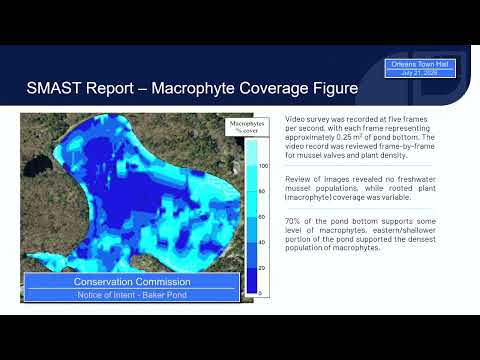
At a town conservation commission meeting, planning director George Missouri and Hannah Raditz of BSC Group presented a notice of intent to apply an alum sulfate treatment to the deepest portion of Baker Pond aimed at reducing available phosphorus and limiting algal blooms.
The project would treat about 4.8 acres — roughly 17% of the 28‑acre pond — targeting pockets 11 meters and deeper. Raditz described the alum application as a chemical flocculant that binds phosphorus, settles into the sediment and prevents that phosphorus from fueling cyanobacteria during seasonal turnover. Raditz said pre‑treatment testing will determine dosage and whether treatment occurs in spring or fall, and that the town provided funding for the work at its May 2026 town meeting.
Commissioners and staff emphasized monitoring and protective conditions. Raditz and staff described a one‑day field operation (with a two‑day buffer), trailing hoses from a flat‑bottom boat, control and monitoring areas, and strict stop criteria: stop if pH moves outside roughly 6.0–8.0, wind speeds exceed about 10 mph (for certain application methods), or fish mortality in the treatment area exceeds 10 on any day. The plan includes monthly sampling from April through October for two years after treatment and an annual report that will summarize total phosphorus, pH, temperature, oxygen profiles and any cyanobacteria events.
Commission members pressed for clarity on several points: whether a contractor has been selected (the town will issue an RFP and follow state procurement), whether the 2019 SMAST data remain representative (Raditz said community sampling continues and proposed an update in the first annual report), and whether stormwater runoff near Baker Pond Road could be a more important source than reported. Raditz said SMAST’s budget showed septic effluent within ~100 meters accounted for roughly 45–76% of phosphorus inputs and that road/roof/runoff combined contributed about 14–24% in spring.
Public commenters echoed technical concerns. Abutter John Ostman asked if an alkaline buffer is included to mitigate pH shifts during and after application; Raditz said mixtures of different alum salts are used to reduce pH spikes and that she would provide a more detailed answer at the continued hearing. Ron Mogadishan said the proposal seemed premature and urged the town to repair drainage infrastructure before an in‑pond chemical treatment.
The commission also discussed ecological follow‑ups raised by the Brewster Conservation Commission, including zooplankton assemblage sampling to track community shifts; staff said they would consult SMAST and consider adding such sampling to the monitoring plan if warranted.
Because the SMAST natural‑heritage checklist is still under review and commission members requested supplemental recent sampling and special‑condition language tailored to Baker Pond, Commissioner (speaker 11) moved to continue the public hearing to Aug. 4, 2026. The motion carried by roll call. The hearing remains open to allow natural heritage comments and supplemental materials; the commission asked staff and BSC to return with a short memo summarizing any sampling since 2019 and a draft set of special conditions adapted from prior alum approvals.
The commission did not vote to approve any order or permit at this meeting; the formal decision will follow further review and the continued hearing.