Get Full Government Meeting Transcripts, Videos, & Alerts Forever!
Get email alerts on the Criminal Justice topic
No spam. Unsubscribe anytime.
U.S. Attorney's office introduces Special Assistant U.S. Attorney for North Idaho
Summary
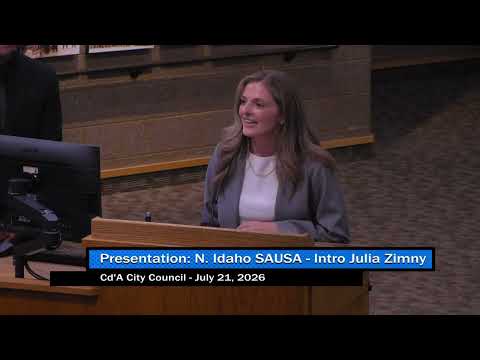
Julia Zimney, introduced at the July 21 Coeur d'Alene City Council meeting, is serving as the office's first Special Assistant U.S. Attorney (SAUSA) for North Idaho and will focus on federal drug prosecutions along the I‑90 corridor while coordinating with local prosecutors.
Julia Zimney, the office's first Special Assistant United States Attorney assigned to North Idaho, was introduced to the Coeur d'Alene City Council on July 21.
Benjamin Allen, identified in the meeting as the Shoshone County prosecutor, said the SAUSA position is a multi‑jurisdictional collaboration and thanked the city for being an early local partner. Zimney said she started in late April and described her role as dedicated to prosecuting drug crimes at the federal level, noting the position differs from an Assistant U.S. Attorney.
"SASA stands for Special Assistant United States Attorney and it is differentiated from Assistant United States Attorney," Zimney said, adding that as a SAUSA she is specifically dedicated to prosecuting drug crimes. She noted she has worked with local prosecutors and with the U.S. Attorney's Office to adopt some state cases for federal prosecution, which she said can save state tax dollars.
Zimney said she has been juggling roughly 20 narcotics‑based cases and has been training with local law enforcement partners. She also said, when asked, that she could not discuss logistics or specifics about active cases because of the nature of the work.
Mayor and council members were introduced to Bryce Ellsworth, described in the meeting as an Assistant U.S. Attorney and Zimney's mentor in the office. Zimney cited the I‑90 corridor as an area where coordinated federal prosecution can help hold individuals accountable for trafficking through the Inland Northwest.
The presentation concluded without council action; Zimney invited questions and said she hoped to return to share statistics about how the position affects local trafficking or savings to the state.