Get Full Government Meeting Transcripts, Videos, & Alerts Forever!
Get email alerts on the Water Quality topic
No spam. Unsubscribe anytime.
Local experts say recent pond algae advisories were short-lived; towns plan longer-term sewer and sediment fixes
Summary
Marine and freshwater quality committee chair and natural resources staff reported short‑duration cyanobacteria advisories that have since been lifted, noted alum treatments have improved pond oxygen and clarity, and outlined sewer and habitat projects as the long-term solution; the Water & Sewer Commission also reported a small PFAS detection that MassDEP asked to re‑sample.
Town volunteers and staff told the Select Board the recent string of cyanobacteria advisories across Orleans ponds were short-lived and that ongoing remediation and sewer work remain essential.
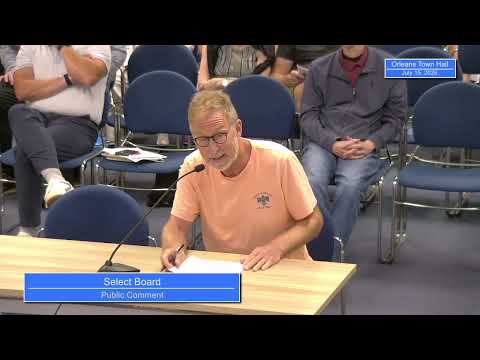
"There were cyanobacteria advisories identified in Uncle Harvey's Pond, Baker's Pond, and Crystal Lake a few weeks ago," Carolyn Audi, chair of the Marine and Freshwater Quality Committee, told the board. "Public advisories were issued, the ponds were retested, and the advisories were lifted. The blooms were short lived." She said alum treatments applied at several ponds since 2021 have increased clarity and dissolved oxygen and are performing as intended while the town continues to build sewer infrastructure to address watershed phosphorus loading.
Nate Sears, deputy director of natural resources, also described ongoing work on the herring run: the town received a roughly $1,000,000 federal natural-resources grant to study and design restoration, the project is about 30% complete and will be reviewed by Division of Marine Fisheries next week, and construction could begin as early as winter 2027. Sears said the herring count this year was "terrible," that glass-eel numbers were good, and that outcomes may not be fully evident for 5–7 years due to the life cycle of diadromous fish.
In liaison updates, the Board of Water and Sewer Commissioners reported a small PFAS detection in a remote well; MassDEP requested resampling and the town will continue annual PFAS monitoring. The board also noted enforcement activity against properties observed irrigating during drought restrictions.
Next steps: continued pond monitoring and alum treatment follow-up, completion of design and permitting for the herring-run restoration, phase 3 and later sewer construction to reduce watershed phosphorus, and resampling for PFAS per MassDEP guidance.