Get Full Government Meeting Transcripts, Videos, & Alerts Forever!
Get email alerts on the Wastewater topic
No spam. Unsubscribe anytime.
Orleans officials outline sewer expansion timeline as residents press on high connection costs
Summary
Town public works director said phase 3 sewer construction will start this fall and property owners in phase 2 have one year to connect after a March notice; residents pressed the board about high private-side connection costs and possible ways to reduce inspection and engineering expenses.
The Orleans Select Board heard a detailed update on the town's multi‑phase sewer program and a string of public concerns about the cost to connect private properties.
Rich Waldo, Orleans director of public works, told the board the town issued a Board of Health 'notice to connect' in March for Meeting House Pond (phase 2) and that affected properties have one year to make connections. He said phase 3 recently went out to bid with State Revolving Fund financing in place and that construction is expected to begin in September.
"We are finally able' to operate a pump station, which will allow us to serve that Meeting House Pond area," Waldo said, describing the work completed under phase 2 and the schedule for phase 3. He added that phase 4 preliminary design was approved at town meeting and that the comprehensive plan contemplates up to 16 phases, subject to later amendment.
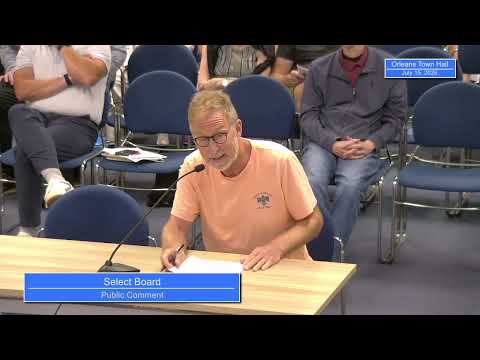
Several residents told the board the private cost of hooking up remains a barrier. One resident described paying nearly $20,000 for a macerating pump installation in another state and said similar work is forcing residents to sell property.
Waldo acknowledged the municipal portion of work typically ends at the property line and that private plumbing costs vary. "We bring it to the property line. That's where our control is," he said, and urged property owners to "get as many quotes and bids as you can because the prices can vary quite a bit from contractor to contractor." He said staff is exploring ways to reduce town‑controlled costs, including limiting inspection fees and allowing certification letters instead of full as‑built plans when appropriate.
Board members and residents also discussed measures aimed at reducing overall nitrogen loads so the number of sewer phases could be reduced, including stormwater work and fertilizer reductions. Waldo said the town is pursuing additional nitrogen credits through stormwater and marsh attenuation projects.
Next steps: phase 3 construction is slated to begin in September, public informational sessions for property owners in phase 2 and phase 3 are planned for the fall, and residents in the affected service areas should expect notices on timing and betterment calculations as projects reach completion.