Get Full Government Meeting Transcripts, Videos, & Alerts Forever!
Get email alerts on the Affordable Housing topic
No spam. Unsubscribe anytime.
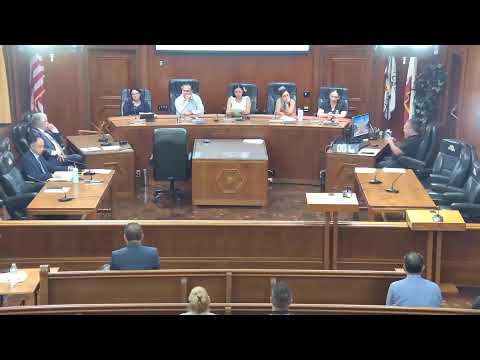
Planning commission approves 14‑unit Habitat for Humanity townhome project at Long Beach Boulevard
Summary
The South Gate Planning Commission on July 21 approved Tentative Tract Map 84210 and four administrative modifications to allow a 14‑unit affordable condominium townhouse project at 9001–9019 Long Beach Boulevard, adopting a Mitigated Negative Declaration and 88 conditions of approval.
The South Gate Planning Commission voted on July 21 to adopt Resolution 2026‑07 approving Tentative Tract Map 84210 and PL 26‑0191, clearing the way for a 14‑unit affordable condominium townhouse development at 9001–9019 Long Beach Boulevard.
Associate Planner Joshua Valdez presented the proposal and the staff recommendation, saying the project consolidates three parcels on a roughly 0.66‑acre site in the city’s Urban Neighborhood zone and would build 14 two‑ and three‑story attached townhomes in four buildings. Valdez said the applicant is the Habitat for Humanity affiliate of Greater Los Angeles and explained the four requested administrative modifications: reduce an interior parking setback from 10 feet to 0 feet; reduce a building setback (Unit 10) from 10 feet to 5 feet; increase the general perimeter fence from 3.0 feet to 3.5 feet; and increase a wall at the southwest corner of Long Beach Boulevard and Willow Place from 3 feet to 6 feet.
Staff recommended certification of a Mitigated Negative Declaration (MND) under the California Environmental Quality Act and adoption of the mitigation measures listed in the initial study. City CEQA consultant Christine Abraham told the commission that, given the project’s scale, most potential effects such as traffic, air quality and greenhouse gases were found to be less than significant; the MND includes mitigation measures for cultural and tribal cultural resources, paleontological resources and for site remediation overseen by the Department of Toxic Substances Control (DTSC).
Habitat for Humanity representative Noah (project designer/affiliate) and Housing Manager Carol Averell described the affordability and funding approach. Averell said the demolition work was paid in part with federal Community Development Block Grant (CDBG) funds allocated specifically to demolition (she identified $225,000 for demolition), while DTSC is funding most of the hazardous‑soil remediation. Averell said the parcels were purchased with former redevelopment/successor‑agency funding and are currently owned by the housing authority; the authority will transfer the properties to Habitat for Humanity after entitlements and disposition‑development agreements are complete. She also said families selected for the program will be at or below 80 percent of Area Median Income and that the city applied for CalHome mortgage assistance funding to provide up to $200,000 in down‑payment assistance per household.
Public commenters raised questions about project costs to the city, the timing and scope of remediation, and the adequacy of the cultural resources analysis. One Zoom speaker asked whether CDBG funds were diverted from park projects; staff responded that some CDBG money was used for demolition because those funds must be expended within a year and that other park projects remain funded. The LA County Sanitation Districts submitted a comment on the project’s sewer capacity and ability to serve the development; staff placed that letter in the record.
Commissioners asked a range of technical questions — including the rationale for the fence‑height changes, emergency access and whether density bonuses were pursued — and staff explained that because the 14 proposed units are within allowed density for the site the project proceeds by right with administrative modifications under South Gate Municipal Code provisions. Staff emphasized that state law and local code provide pathways to grant concessions for 100 percent affordable housing projects.
After deliberation and with corrections to typographical errors in plan attachments, a commissioner moved to approve the project with the 88 conditions of approval and acceptance of the MND. Roll call votes were recorded and the motion passed. The resolution and the conditions of approval will be finalized in the project record.
The commission’s action is procedural: the entitlement approval allows a final map to be prepared and forwarded to the City Council for final review in accordance with the municipal code; DTSC oversight and the mitigation monitoring and reporting program will guide remediation and mitigation compliance prior to groundbreaking.