Get Full Government Meeting Transcripts, Videos, & Alerts Forever!
Get email alerts on the Medicaid Funding topic
No spam. Unsubscribe anytime.
Governor Beshear moves $255 million in surplus to restore Medicaid funding, avert 4% provider cut
Summary
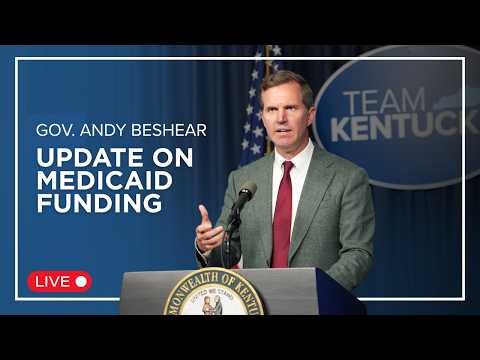
At a state briefing, Governor Beshear said his administration will apply $255,000,000 of unexpected surplus and a one-time corporate tax payment to close a Medicaid funding gap, fully fund existing waiver slots and add $4,000,000 for senior meals; notices halting planned 4% provider cuts are being issued to providers.
At a press briefing, Governor Beshear announced his administration will apply $255,000,000 of unexpected surplus and a large, unbudgeted corporate income tax payment toward closing a Medicaid funding gap and reversing recent cuts.
Beshear said the state turned an anticipated $156 million shortfall into a $476 million surplus and that July collections included more than $350 million in corporate income tax payments, producing roughly $781 million in funds available now. "Today, I'm announcing that I'm taking action," Beshear said, adding that the move will prevent a planned 4% Medicaid provider fee-schedule cut this year.
The announcement matters, the governor said, because it preserves provider payments and services for Kentuckians who rely on Medicaid. "These dollars weren't expected by anyone, including the General Assembly," Beshear said, arguing the funds let the administration "reverse cuts and prevent painful impacts to our Kentucky families."
Dr. Stack, who addressed the implications for the Cabinet for Health and Family Services, told the briefing the budget passed by the General Assembly provided no new dollars to keep pace with Medicaid inflationary growth and that "we will not be implementing a 4% Medicaid provider fee schedule cut Aug. 1 or after in 2027." He credited citizen advocacy and a sign-on letter from roughly 200 provider groups and nonprofits for helping persuade officials to find a path to avoid the cuts.
Health care providers also spoke at the briefing. "When Medicaid remains strong, patients receive care before small problems become large ones," said Dr. Matt Burchitt, a practicing optometrist who said he treats patients across rural Kentucky. A parent who spoke, Rebecca Lau, described losing Medicaid coverage for her 8-year-old son with autism and said the family had spent $30,860.50 out of pocket to pay for services. "Kentucky families deserve better," she said.
Beshear said the administration will also use surplus funds to fully fund existing waiver slots that the governor said were underfunded by the legislature, and to add $4,000,000 this fiscal year for senior meals. The governor said he has already directed more than $200,000,000 of efficiency savings to address some shortfalls and that, even after the investment in Medicaid, his plan will deposit more than $400,000,000 into the budget reserve trust fund.
The governor acknowledged the unusual nature of the move and flagged a possible legal or legislative response. "Will they applaud the move or sue to reverse it? If so, they will force painful cuts," he said.
In the question-and-answer session, Beshear said the one large corporate tax payment is not expected every month and that the Department of Revenue is legally barred from disclosing the payer. He also said the administration had halted letters notifying providers about the planned 4% reduction and that new notices stopping those letters were being sent.
Beshear also reviewed a prior executive order that reduced the gas tax by 10 cents per gallon and said his team identified funding to restore at least $18,000,000 to the road fund and to revenue shared with counties and cities.
The governor and the cabinet emphasized that while the administration's actions avert immediate cuts, legislative work will still be needed in 2027 because deeper cuts remain in the two-year budget passed by the General Assembly. Dr. Stack said the legislature will still need to address the issues when it reconvenes.
The briefing closed after a series of questions from reporters about whether the governor had consulted legislative leaders in advance, how recurring the tax payment might be and how the administration assembled the savings it used. Beshear said he had briefed the Democratic caucus shortly before the event but had not personally briefed legislative leaders in advance of the public announcement. He said the administration will continue to seek ways to protect essential services.
The administration described these as executive funding decisions rather than new legislation; any legal or legislative challenge to the transfers would be decided through the appropriate processes.