Get Full Government Meeting Transcripts, Videos, & Alerts Forever!
Get email alerts on the Zoning Fence topic
No spam. Unsubscribe anytime.
Roeland Park City board rejects fence variance at 5419 West 51st Street
Summary
The Roeland Park City Board of Zoning Appeals denied a request to extend and raise a corner-lot fence at 5419 West 51st Street after staff and neighbors raised precedent and code concerns; the variance failed when the board did not meet the required three affirmative votes on the uniqueness test.
The Roeland Park City Board of Zoning Appeals denied a variance request from homeowners seeking to extend a 5-foot cedar picket fence closer to the street at 5419 West 51st Street.
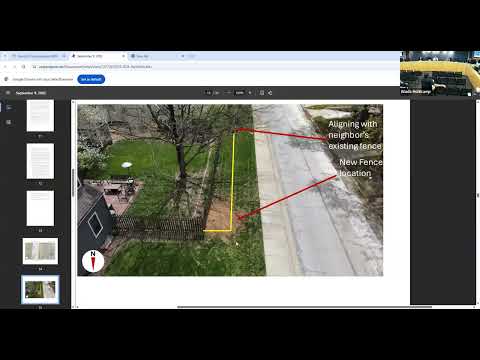
Wade Holtkamp, the city building inspector, said the applicants sought to push an existing 5-foot fence out to align with a neighbor and to keep a picket style, but that city code limits side-yard fences on corner lots to 42 inches unless a 15-foot setback is met. Holtkamp told the board the proposed location appears to be outside the site-distance triangle but that granting the variance could set an undesirable precedent.
The applicants, Liz Vogel and co-applicant Mark Eilman, asked the board to allow a roughly 60-inch fence to reclaim garden space. "We're just requesting to extend the footprint of our current fence," Vogel said, describing the design as the same cedar picket style and saying she and her husband wanted more gardening space.
Neighbor Thomas Madigan, who identified himself as an elected official and a corner-lot owner, told the board the applicants followed the process and urged the board to consider fairness for corner-lot owners. "This couple is trying to do the right thing," Madigan said, adding that other nonstandard fences exist in the city.
City attorney Alex Belozin explained how the board could tailor findings if it wanted to approve a variance, for example by citing the house's deep setback or the fact that the proposed location did not affect the site-distance triangle. The board, however, first voted on the required uniqueness criterion and, per the roll call recorded on the transcript, the uniqueness test did not pass; the chair read the votes and the board recorded more negatives than affirmatives, causing the variance application to fail without proceeding through the remaining criteria.
Because the board failed the first test, no further findings were adopted and the application was denied. The applicants may revise their proposal (for example, to match the 42-inch height allowed at the right-of-way line) or submit additional documentation in a future application. The board moved on to the next agenda item at the same meeting.