Get Full Government Meeting Transcripts, Videos, & Alerts Forever!
Get email alerts on the School Facilities topic
No spam. Unsubscribe anytime.
Consultants present four school reconfiguration scenarios; superintendent urges community input on possible late‑summer bond
Summary
Consultants from HTK presented four configuration options for Santa Fe Trail schools — from reusing existing space to a one‑campus model — with capital estimates ranging roughly from $13 million to $53 million. The district will refine scenarios, bring a finance briefing next month and could target an August/September bond election.
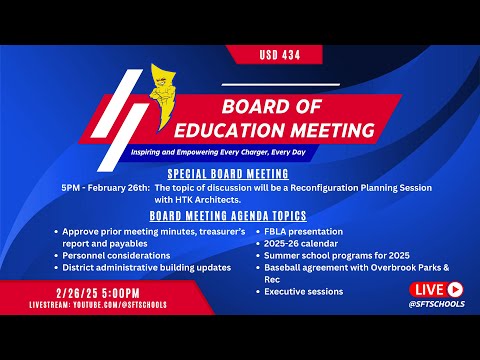
Consultants from HTK told the Santa Fe Trail school board they had narrowed facility options to four broad scenarios after listening to town halls in 2022–23 and completing building assessments, then walked the board through costs, program tradeoffs and next steps.
"We're not picking a solution tonight," Maria of HTK said, opening the presentation and emphasizing the team had completed research and brought options for feedback. Consultants said the study focused on three priorities identified by the community: the student learning environment, enrollment configuration and operational (staffing) efficiency.
The options ranged from a reconfiguration-only approach that repurposes existing space to a one‑campus model that would concentrate most grades at the high‑school site. The consultants presented preliminary cost ranges the board discussed: about $44 million–$53 million for the one‑campus option, roughly $24 million–$30 million for a two‑campus model, and a lower‑cost option shown in the materials as about $13.18 million for a three‑campus scenario. Consultants also listed about $1.75 million in priority capital and maintenance work for one building as an example of upgrades the district would face in any scenario.
Board members pressed on program details: parking and playground siting for a reconfigured high‑school campus, how many gyms would be needed under different configurations and the limited CTE/woodshop space and ventilation at the current high‑school facility that constrains hands‑on instruction. The consultants recommended additional engineering and site work before final designs and said administrative office locations (for example if Scranton were vacated) would have to be addressed in some options.
Superintendent (role identified in the meeting) said community buy‑in would be essential and urged a careful, research‑focused process. "Student learning is always at the forefront of my mind with all of this," she said, asking that scenario choice be tied to evidence about transitions and learning outcomes.
Next steps the presenters outlined included refining scenarios with building leaders and the community, convening a steering committee to broaden participation and scheduling a finance briefing with a district finance staffer (Clayton) next month to translate scenarios into tax and ballot language. Consultants said, if the board chose to pursue a bond, a special election could be scheduled in late August or early September once costs and configurations are finalized and the district prepares the voter education materials.
The board did not take a vote on any configuration at this meeting. Members asked staff to return with more detailed cost and tax‑impact figures, and several asked consultants to model phased approaches that could reduce up‑front cost while addressing urgent facility needs first.