Get Full Government Meeting Transcripts, Videos, & Alerts Forever!
Get email alerts on the Local Taxation topic
No spam. Unsubscribe anytime.
Codington County adopts 0.5% gross receipts tax to fund property tax relief
Summary
By a 4–1 roll-call vote, the Codington County Board of Commissioners adopted Ordinance No. 83 to impose a 0.5% county gross receipts and use tax effective Jan. 1, 2027; commissioners cited projected revenue and homeowner relief while a public commenter warned the tax is regressive.
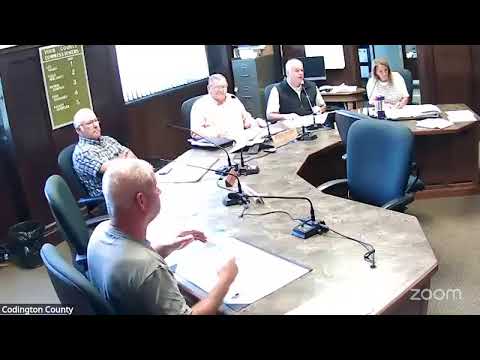
The Codington County Board of Commissioners voted 4–1 on July 21 to adopt Ordinance No. 83, imposing a 0.5% county gross receipts tax and matching use tax beginning Jan. 1, 2027, to fund a property tax reduction fund for owner-occupied homes. Commissioner Zach Gable read the ordinance during the meeting’s second reading and said the tax would be collected and administered under South Dakota Codified Law 10-52B.
The measure, proposed as a means to provide property-tax relief for owner-occupied properties, was framed by supporters as a way to create a dedicated property tax reduction fund administered according to state statute. Commissioner Gable offered a rough county revenue estimate based on Watertown’s 2025 taxable sales, suggesting in-round numbers of approximately $5,600,000 annually, and cited a state projection that an owner-occupied house with a $350,000 valuation could see about $821 in annual property-tax savings under the program.
Doug Allen, a member of the public who spoke during the hearing, urged commissioners to consider the ordinance’s distributional effects. "I kinda stand opposed to this," Allen said, arguing the tax is regressive and would hit low-income residents and non-homeowners who still pay sales taxes on everyday purchases.
Commissioners discussed implementation mechanics, including whether to use projected receipts immediately to offset levies or to wait for actual revenue receipts and to consult auditors and the treasurer on the timing. County staff confirmed that revenues collected under the ordinance would be deposited into a dedicated property tax reduction fund and that the South Dakota Department of Revenue would collect the tax in the same manner as state retail sales and use taxes.
The board conducted a roll-call vote after discussion. The clerk recorded votes as: Van Duzen — Aye; Johnson — Aye; Schwier — Aye; McElhaney — Nay; Gable — Aye. The chair declared the motion carried, adopting Ordinance No. 83.
Next steps identified during the meeting included county staff coordinating with the auditor and treasurer to determine when and how to apply receipts to the property tax levy and whether to use projections in the first year or wait for confirmed collections. The ordinance text cites South Dakota Codified Laws 10-45 (retail occupational sales and service tax), 10-46 (use tax), and 10-52B (county option county gross receipts tax for property tax reduction) as the statutory framework under which the county will operate the tax.
The ordinance takes effect Jan. 1, 2027; staff and commissioners said further administrative decisions about timing of distributions and projection methods will be addressed in subsequent budget and administrative meetings.