Get Full Government Meeting Transcripts, Videos, & Alerts Forever!
Get email alerts on the School Finance topic
No spam. Unsubscribe anytime.
Wythe County supervisors place 1% local-option sales tax for school projects on November ballot
Summary
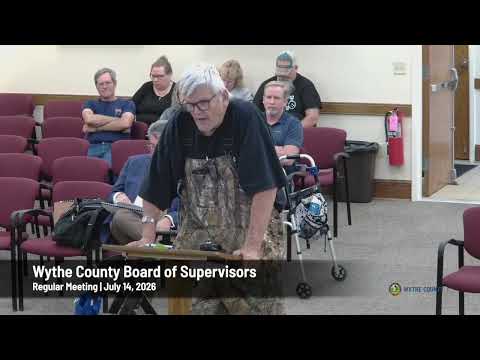
After a presentation showing the tax could fund roughly $72 million in school construction and renovation, the Wythe County Board of Supervisors voted July 14 to place a 1% local-option sales tax question on the Nov. 3 ballot so voters can decide whether to fund school projects including Spiller Elementary and Fort Chiswell High School.
On July 14, 2026 the Wythe County Board of Supervisors voted to place a proposed 1% local-option sales tax on the November 3 ballot that, if approved by voters and later enacted by the board, would be restricted to school construction and renovation.
Mister Cooch, the county's financial adviser, presented an analysis the board described as showing the tax could support roughly $60–$72 million in projects. "This is perhaps in my 30 years of public finance in Virginia... one of the most transformative new revenue sources that has respect to schools and school construction," Cooch told the board, outlining scenarios that assumed conservative annual receipts of about $5 million and a more likely case closer to $6 million after carve-outs for grocery and hygiene items.
The presentation listed project estimates of about $72 million in total needs: a roughly $40 million Spiller Elementary School project, a $25 million Fort Chiswell High School renovation, roughly $5 million for athletic-field improvements and about $2 million for roof and chiller repairs. Cooch said the county could leverage the annual tax receipts through debt service to accelerate construction without drawing on the general fund and explained timing constraints tied to referendum filing and ordinance enactment.
The school board earlier adopted a resolution supporting placement of the question on the ballot. "Our board was in support of our citizens being able to put this on the ballot and make that choice," Dr. Street, the county's new superintendent, said. He said the revenue "would be very impactful for the school system, for our kids, and for our teachers and staff." Dr. Street also gave an operational update on the school cannery and said it is expected to be ready for use pending inspector approval.
Several supervisors and staff asked technical questions about revenue assumptions and the share of receipts attributable to visitors and interstate traffic. Staff noted a statutory carve-out for food for human consumption and certain personal hygiene products that reduces the taxable base and that, under the new legislation described in the presentation, the county would not be required to share proceeds with towns.
A resolution to place the 1% local-option sales tax question on the Nov. 3 ballot was moved by Mr. Turry, seconded by Mr. Mark Morgan and approved by roll-call vote. Chair Smith emphasized that the board was only authorizing placement of the question on the ballot and was not enacting the tax itself; the tax would only take effect if voters approve the referendum and the board later adopts an ordinance and the statutory waiting periods and timing requirements are met.
The board packet and Cooch's presentation included schedules showing cash-flow scenarios, assumed planning interest rates and projected debt-service coverage. If voters approve the referendum, staff said collections could begin in fiscal 2028 under the timetable discussed, with limits on when construction can begin prior to the tax's effective date.
The board will next consider any implementing ordinance and related debt issuance steps only after the referendum process and any subsequent voter approval.