Get Full Government Meeting Transcripts, Videos, & Alerts Forever!
Get email alerts on the Bridal Nations Summit topic
No spam. Unsubscribe anytime.
City briefs committee on Bridal Nations Summit commitments, Skagit settlement and tribal partnerships
Summary
Office of Intergovernmental Relations and partners briefed the council committee on progress implementing Bridal Nations Summit commitments, including City Light’s Skagit relicensing settlement with tribes, water and fisheries work, stewardship partnerships and behavioral-health investments.
The Office of Intergovernmental Relations told the Seattle Finance, Native Communities and Tribal Governments Committee on July 21 that departments are tracking progress on Bridal Nations Summit commitments spanning resource stewardship, culturally attuned systems of care and intergovernmental coordination.
Nina Hashemi, director of OIR, said the summit provides an official forum for government-to-government engagement and that the city is among a small number of municipalities that convene tribal leaders with department and elected leadership. "The summit provides an official opportunity for the city to identify actions and outcomes to uphold the sovereignty and treaty rights of federally recognized tribes," Hashemi said.
Presenters highlighted several concrete initiatives. City Light filed an amended license application this June as part of Skagit River hydroelectric relicensing and negotiated a comprehensive settlement that includes separate agreements with the Upper Skagit, Swinomish and Sauk-Suiattle tribes. The settlement, presenters said, provides financial compensation, tribal employment and education programs, funding for cultural centers and commitments to energy-efficiency investments on tribal land.
Seattle Public Utilities described continued work on tribal fisheries, including Cedar River hatchery activities and early-stage watershed planning (beginning with Thornton Creek) to address culvert fish passage. The Green Seattle Partnership renewed stewardship agreements and identified Native-led organizations to lead restoration at sites such as Daybreak Star.
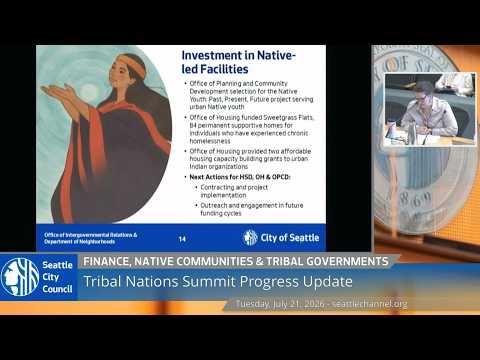
The city also noted investments in behavioral health and shelters: the council approved a $4.8 million investment to support the Seattle Indian Health Board’s Thunderbird Treatment Center, a 92‑bed inpatient facility on Vashon Island, and Office of Housing awards that included Sweetgrass Flats, adding 84 units of supportive housing.
Committee members thanked presenters and Chair Strauss proposed a field visit to Skagit County next year to review relicensing outcomes and meet tribal partners. OIR staff said they will return to the committee with additional updates and that many commitments remain multi-year efforts requiring continued interdepartmental coordination.