Get Full Government Meeting Transcripts, Videos, & Alerts Forever!
Get email alerts on the Transit topic
No spam. Unsubscribe anytime.
Seattle council sends 10‑year transit sales‑tax measure to November ballot
Summary
On July 21, 2026 the Seattle City Council voted unanimously to place a 10‑year, 0.3% sales/use tax transit measure on the Nov. 3 ballot, with amendments adding reporting deadlines and studies of school‑adjacent routes; sponsors estimated about $1.4 billion in revenue and 100,000 additional service hours.
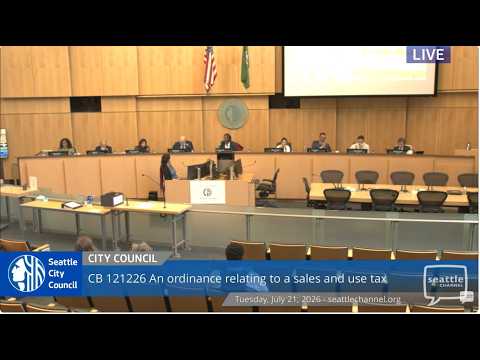
Seattle City Council voted 9‑0 on July 21, 2026 to approve council bill 121226, sending a 10‑year, 0.3% sales and use tax proposition to the Nov. 3 ballot to fund transit service and related programs.
Chair and sponsor Council member Rob Saka framed the vote as the next step in a months‑long public process: “Today isn’t the finish line. … We listened. We debated. We compromised. And we improved this proposal together,” he said in closing remarks, asking voters to judge the council’s work.
The measure, as amended, includes strengthened reporting and oversight deadlines (amendment A), a shifted reporting deadline for one study to March 2028 (amendment B), direction that SDOT study routes near middle and high schools and community centers to address overcrowding (amendment C), and additional public performance reporting on fare‑box recovery, on‑time performance and reliability (amendment D). Council members said those changes aim to balance accountability with implementation feasibility.
Supporters pointed to ridership, climate goals and equity. Council member Kim Rink highlighted the service expansion, saying the package will add roughly 100,000 service hours that “will make a meaningful difference for everyday people.” Transit union and operator groups urged the council to vote yes: Greg Woodfield, president of ATU 587, told members the union would mobilize for the measure and called it a jobs‑supporting investment.
Some members, including Council member Teresa Rivera, warned that the funding mechanism is regressive because it is a sales tax and urged care with affordability. Rivera said the council must weigh the tax’s impact on low‑income residents even while supporting increased transit.
Public testimony before the vote included transit advocates and operators. Jason Lee of Fix the Late and Transportation Choices Coalition executive director Kirk Hovancotter both urged passage, stressing expanded access for shift workers and improved reliability on corridors including Interbay.
The final roll call recorded nine votes in favor and none opposed. Council members who spoke in favor emphasized oversight provisions and partnership with King County Metro and SDOT; opponents were not recorded. With the council’s passage, the ordinance will be placed on the Nov. 3, 2026 ballot for voter approval.
What happens next: the measure moves to the November ballot; council members and city agencies said they will continue outreach and coordination with Metro and SDOT to prepare implementation plans and reporting required by the ordinance.