Get Full Government Meeting Transcripts, Videos, & Alerts Forever!
Get email alerts on the Land Use Data Center topic
No spam. Unsubscribe anytime.
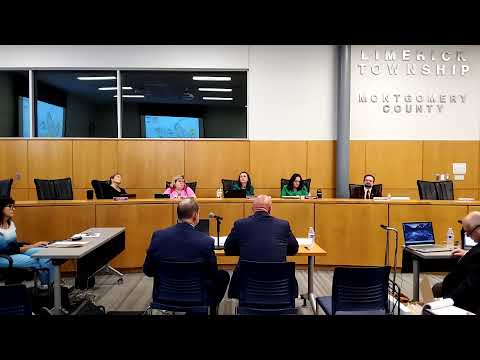
Limerick board continues contentious MCD 7 data‑center hearing amid dispute over floodplain crossings, utilities and noise
Summary
The Limerick Township Board of Supervisors continued a public conditional‑use hearing for MCD 7, LLC’s proposed data‑center campus after extended testimony on road crossings through floodplain areas, utility crossings, stormwater and noise; the board recessed and set a continuation for Aug. 18, 2026.
The Limerick Township Board of Supervisors on July 21 continued the public hearing on Conditional Use Application 25‑4 from MCD 7, LLC after hours of technical testimony and public questioning about whether the proposed data‑center campus can cross waterways and the floodplain without zoning relief and how utilities, stormwater and noise will be managed.
Chair (speaker 3) opened the hearing and reminded those present that "This is a formal quasi judicial proceeding governed by the Pennsylvania Municipalities Planning Code," outlining the recordkeeping and cross‑examination rules the board will follow. Counsel and witnesses then reviewed plan sheets and alternatives submitted as exhibits.
The applicant’s project manager, McNaughton (speaker 1), told the board the internal vehicular accesses shown on Exhibit A‑2 were intended as privately controlled campus accesses with gates and guardhouses, not public thoroughfares, and that an alternate Exhibit A‑4 removes those driveways while providing a concrete, encased electrical duct bank to carry utilities under stream crossings. McNaughton said the duct bank crossings would be installed beneath the flood‑plain cross‑section, and that "They will be restored to the precondition or if the permit requires additional improvements, those will be made as well." He added that future maintenance of buried utilities could require temporary disturbance of the floodplain and that detailed utility routing is typically finalized during land‑development and permitting.
Board questioners pressed whether the ordinance’s provision that prohibits "filling, piping, or diverting" in protected floodplain areas except for "required roads" (section 1‑84‑81(e)) means the applicant must first obtain zoning relief before any utility or access crossings are allowed. The applicant’s counsel and the witness disagreed about the ordinance’s reading: the applicant argued crossings are regulated under the township’s flood‑damage prevention chapter and can be permitted if the flood‑plain manager authorizes them with appropriate permits; opponents argued the zoning section precludes crossings other than required roads without explicit zoning relief.
Water and sewer capacity drew repeated questions. McNaughton said the developer has submitted a "large‑load" application to Pennsylvania American Water and that, based on applicant discussions, system upgrades (including possible expansion of wastewater treatment) would be required and are expected to be funded by the developer, although final cost and contract language remain to be negotiated. "That'll be the developer," he said when asked who would pay for upgrades.
On power, project principal Maris (speaker 2) testified about a preliminary PECO high‑voltage interconnection feasibility study, saying that PECO’s initial review indicates that, with system upgrades, "750 megawatts could be supplied to the site," but he stressed that PECO’s letter is a preliminary assessment and not a binding guarantee and that further PJM and PECO engineering and agreements would be required.
Residents and party‑status participants repeatedly pressed technical topics that will be handled by specialist witnesses at later hearings: acoustical and vibration control (noise experts will present models and monitoring plans); generator and chiller specifications (to be provided by the data‑center consultant); stormwater infiltration testing and final grading (to be completed during land development); and precise road‑relocation or vacation terms tied to proposed ordinances. Several attendees asked about emergency access and whether the internal campus roads would allow EMS to move across the site; McNaughton said the accesses were intended to support internal circulation and emergency response but that final design details remain subject to further design work.
The board did not take a final vote on the conditional‑use application. With additional witnesses still to be called and outstanding technical studies to be submitted, the board recessed and voted to continue the hearing on Aug. 18, 2026 at 6:30 p.m. at the township building. Documents referenced at the hearing included the township zoning sections on data‑center standards and flood‑damage prevention, engineering review letters, and multiple plan exhibits supplied by the applicant.
What happens next: the applicant plans to present acoustical and vibration experts, a data‑center consultant to explain generator and chiller design, and additional documentation (power‑system studies, updated will‑serve letters and engineering revisions). The board will reopen the record at the continuation date and evaluate whether the conditional‑use criteria can be satisfied without zoning relief for the proposed crossings and other site elements.