Get Full Government Meeting Transcripts, Videos, & Alerts Forever!
Get email alerts on the School Meals Policy topic
No spam. Unsubscribe anytime.
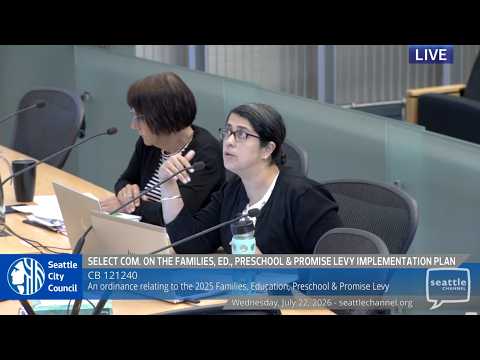
Debate over school meals dominates FEPP committee hearing: vouchers for breaks vs faster universal roll-out
Summary
Dozens of public commenters and council members clashed July 22 over amendment 6 to the FEPP levy I&E plan: proponents argued a targeted voucher program would get food to the neediest during weekends and breaks, while opponents said delaying universal school meals risks equity, stigma and a reliance on uncertain funding.
A heated public-comment period and sustained committee debate over the sequencing and design of school-meal investments dominated the July 22 select-committee meeting on the FEPP levy I&E plan.
Supporters of amendment 6, including council president Hollingsworth and coalition representatives, urged the committee to create a new food-assistance line that would provide vouchers or grocery cards to low-income students for weekends and school breaks and to fund that line by delaying the launch of universal school meals for one year. Victor Jago of FMS Global Strategies told the committee: "Treating every household the same is not neutral. It produces unequal outcomes," and urged adoption of amendment 6 version 2 to preserve funds for targeted assistance now while preserving universal meals the following year.
Opponents and many educators, parents and students argued that universal free school meals remove paperwork barriers and stigma and provide the broadest and most reliable safety net. A number of speakers told the committee they had seen students miss class or struggle to learn when hungry; student and teacher testimony emphasized administrative barriers that prevent eligible children from accessing meals. Dawn Mason, a former state representative, said she opposed the proposed sequencing, arguing the measure risked diverting funds from children in the highest-need neighborhoods.
Council debate reflected the split in public testimony. Council members who supported amendment 6 framed it as an implementation and targeting choice meant to reach students during out-of-school times when cafeterias are closed; those opposed warned that delaying universal meals introduces risk to a promise many in the community now expect. Council member Saka recounted personal experience with paperwork barriers and emphasized launching universal meals immediately to reduce stigma and barriers for immigrant and low-income families.
What the amendment does Amendment 6 creates a new FEPP food-assistance program to provide vouchers/grocery cards to low-income students for weekends and school breaks (excluding summer). Central staff described adding roughly $500,000 per year over the six-year levy to fund this line; combined with resources from amendment 4, supporters said the changes would yield roughly $3.9 million over the levy life to double the city's current investment in weekend/break food assistance.
Responses and implementation Supporters said the voucher approach leverages existing school-based McKinney-Vento and family-support staff to identify students in need; opponents raised concerns about means-testing, administrative burden, and whether the funding shift depends on uncertain future revenues (for example, the proposed millionaire's tax). Central staff and DEEL were asked to produce implementation plans, outcome targets and reporting that will be required should the full council approve the committee's recommendation.
Representative quotes "We intended to feed the most needy," said Elmer Dixon, invoking the Black Panthers' original breakfast program and urging equity-focused targeting. "This plan dresses up a handout to the wealthy as justice for the poor," said Dawn Mason, who opposed amendment 6. "The food assistance program provides support for students from low income families in need of food assistance over weekends and school breaks," central staff summarized when describing the amendment's mechanics.
Next steps Amendment 6 passed in committee and will be part of the I&E plan transmitted to full council on July 28. DEEL and Seattle Public Schools will be responsible for developing distribution protocols, outcome measures and fiscal reporting for the new food-assistance line; central staff will track rebid and procurement cycles per amendment 14.