Get Full Government Meeting Transcripts, Videos, & Alerts Forever!
Get email alerts on the Transportation topic
No spam. Unsubscribe anytime.
Community Board 2 advances response to DOT’s Canal Street West redesign after split public reaction
Summary
DOT presented a Canal Street West redesign emphasizing a two‑way protected bike lane on parts of Canal and Grand Street; public commenters split between welcoming safety upgrades and opposing a two‑way Grand Street bike lane. The executive committee voted to forward a resolution responding to DOT with requests for hardened corner protection, data sharing and stronger vendor enforcement.
DOT’s redesign for Canal Street West — which includes a two‑way protected bike lane on parts of Canal and a conversion on Grand Street — drew a crowded public forum and a divided vote by Community Board 2’s executive committee Wednesday night.
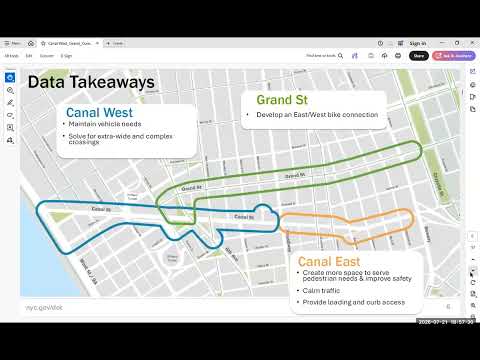
Dan Wagner, a presenter with the DOT team, told the board the plan’s near‑term focus is the west side of the canal, listing project goals as “reliev[ing] pedestrian routing and improve[ing] sidewalk accessibility,” simplifying complex intersections and creating better bike connections. DOT said data show heavy pedestrian volumes on the west side and a higher concentration of severe injuries and fatalities on the east side, prompting a phased approach that puts early work on the west side and returns to east‑side design in 2027.
The DOT presentation, led by Wagner and project manager Preston Johnson, described block‑level design details: a continuous two‑way protected bike lane on the south curb of selected Canal Street blocks, new concrete islands and painted curb extensions at crosswalks, daylighting at intersections, and targeted curb‑use changes to increase loading and passenger access. Johnson said the Grand Street segment would convert an existing eastbound protected lane into a two‑way protected facility in many 30–34‑foot cross sections, a change that will remove some on‑street parking on narrow blocks.
Board members pressed DOT on technical points. Preston Johnson said certain sections would be parking‑protected while other short segments would use concrete or Jersey‑style separators; he added that hotel loading zones and some floating parking would remain to provide passenger drop‑offs. An agency traffic engineer described multi‑period traffic modeling and said banning left turns at West Broadway and Green Street would reroute vehicles with modest per‑driver time penalties (DOT estimated about a minute or two for some origins) while reducing more severe through‑traffic delays caused by left‑turners.
Public comments were strongly mixed. Ronnie Wolf, speaking for residents and business owners near Grand Street, told the board: “We strongly oppose installing a 2 way bike lane on Grand Street,” arguing the street is narrow, heavily used by seniors and people with strollers, and that many cyclists “breeze through intersections while not abiding by any of the rules of the road.” Several other speakers echoed concerns about sidewalk crowding, deliveries and the impact of left‑turn bans on local circulation.
Other residents supported DOT’s proposal. Luke Cameron said the redesign is “objectively good, long overdue, and will save lives,” praising curb extensions and shortened crossing distances. Multiple commenters asked DOT to share slides and data in advance of meetings and to coordinate with NYPD and City Hall on enforcement of illegal vending, which they said exacerbates sidewalk crowding.
Committee members amended the draft resolution to strengthen calls for hardened curb protection at high‑risk corners, clearer curb‑management signage for loading and passenger zones, and a request that DOT provide data used in rerouting and traffic models to the board. The executive committee voted to advance the resolution to the full board; the meeting record shows the motion carried despite several recorded oppositions during the roll call. The committee’s action frames CB2’s response as a set of requests and conditions rather than an unconditional endorsement.
DOT said some hardened elements can be installed quickly — granite blocks or concrete curb hardening where feasible — but that larger resiliency measures (for flooding) require separate capital funding and a multi‑year timeline. Presenters also said they intend to begin some implementation later in 2026 and return with east‑side proposals in 2027 for further study.
Next steps: DOT will provide the board with the presentation slides and the traffic‑modeling data requested by members; Community Board 2’s full board will consider the executive committee’s resolution at its next board meeting.