Get Full Government Meeting Transcripts, Videos, & Alerts Forever!
Get email alerts on the Planning And Zoning topic
No spam. Unsubscribe anytime.
Council adopts citywide land-development code updates and a sidewalk inspection program
Summary
The council unanimously approved city-initiated amendments to Title 19 (chapters 19.12/19.14 and chapter 19.19) to tighten phase-site-plan requirements and adjust open-space amenity rules, and it adopted a sidewalk inspection and maintenance resolution establishing prioritization and a process for repairs.
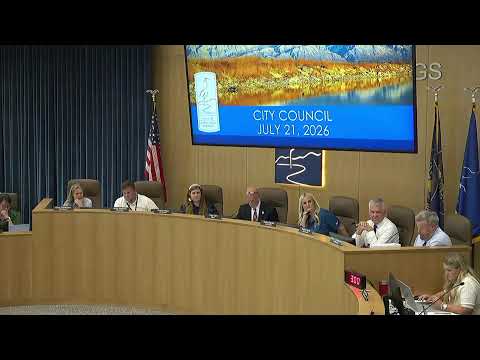
Saratoga Springs City Council on July 21 unanimously approved multiple city-initiated land-development code changes and a sidewalk inspection and maintenance resolution.
Staff presented two separate code updates. The first amends chapters 19.12 and 19.14 to require additional conceptual plans and construction drawings for phased nonresidential site plans and to clarify courtesy-notice and rollback/property-tax requirements at plat recordation. Council approved the ordinance (recorded as Ordinance 2631) with the findings and conditions recommended by staff.
The second, an amendment to chapter 19.19 (open space and minimum-required amenities), returns after earlier review and removes a uniform restroom-per-acre requirement pending updates to the parks, recreation and open-space master plan. The amendment broadens amenity flexibility by requiring developers to select at least three amenity categories, caps equivalent-acre credit at 25 percent and clarifies that public amenities may qualify for impact-fee credits. Council approved the change with staff’s findings and conditions.
Separately, council adopted a resolution formalizing an inspection and maintenance program for sidewalks (Resolution R-26-43). Staff described using Transportation Asset Management (TAM) teams to identify trip hazards and a prioritization process to allocate limited repair resources. Council asked staff to monitor budget adequacy for ongoing maintenance; staff said current allocations have been sufficient but will report if new issues arise.
All three measures passed on unanimous roll-call votes.
The approved code amendments change city review expectations for phased nonresidential development and give developers more flexibility but place guardrails (credit caps and master-plan alignment) on open-space amenity options. The sidewalk program provides a formalized process for inspection, prioritization and budgeting for repairs.