Get Full Government Meeting Transcripts, Videos, & Alerts Forever!
Get email alerts on the Development Code Rewrite topic
No spam. Unsubscribe anytime.
City staff present broad rewrite of Sedro-Woolley development code to streamline permitting
Summary
City planning staff presented a repeal-and-replace package for consolidated planning procedures to align Sedro-Woolley code with recent state law and the city's comprehensive plan; commissioners praised clarity improvements but pressed staff for fixes on SEPA timing, ADU/unit-lot definitions and density calculations.
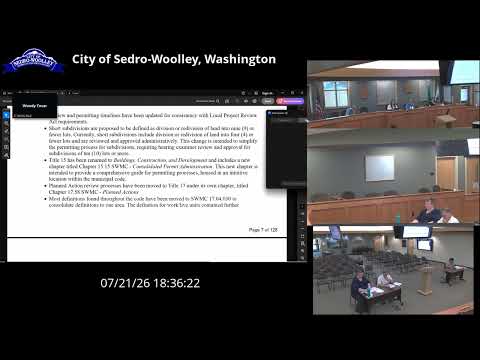
Sedro-Woolley planning staff presented a comprehensive rewrite of multiple municipal-code titles on July 21, saying the package responds to recent state legislation and direction in the city's new comprehensive plan.
Tom Glover, the city's community development director, told the commission the effort pulls decades of provisions into a modern, navigable structure and implements changes required by the Local Project Review Act and recently referenced state legislation (identified in the packet as Senate Bill 5290). Nicole, a city planning staff member leading the draft, said the consolidated chapter has not been substantially updated since 2008 and that the rewrite moves permit administration into a single place (Title 15), consolidates definitions, replaces lengthy lists with tables, and updates review timelines to match state requirements. "This chapter of the code hasn't been updated since 2008," Nicole said, "so you'll see a lot of outdated things in that chapter." (Nicole, staff member)
Commissioners broadly supported the reorganization as a user-friendly change. Commissioner Bowman said tables and a clearer flow will save applicants and staff time and praised the draft work as "phenomenal." Several commissioners encouraged staff to orient the packet so a first-time applicant can follow a single flow—"get a pre-app" as step one—rather than hunting for discrete provisions in different chapters.
The commission focused on several recurring technical issues staff plans to refine. Commissioners asked for clearer links between permit type tables and decision authority, so applicants will immediately know whether a hearing examiner, the planning commission or the city council takes a particular action. Staff said the tables will list staff contact and decision authority and will be followed by a general process description.
SEPA procedures and timelines drew detailed questions. Staff confirmed that application materials and SEPA checklists are posted in the public portal the same day notices go out, and that an applicant may have up to six months to request issuance after approval; in some scenarios a project could effectively have up to about 2.5 years from approval to complete construction depending on payment and extension timing. Nicole said the draft attempts to add clarity to application-expiration rules to avoid projects idling in an approved-but-unissued state.
Another major thread was how definitions for ADUs, duplexes and unit-lot subdivisions interact. Commissioners warned that combination of unit-lot subdivisions, attached ADUs and recent title/condominium work could allow more dwelling units on a site than intended. Nicole said the city's legal team has asked for new, specific definitions (unit lot, parent lot, unit of entitlement) and staff is still refining that language. "There's a list of them in there," she said of the new definitions, and staff expects further adjustments after legal review.
On density, commissioners debated whether net-density calculations should exclude unbuildable areas (critical areas, rights-of-way) or count wider development-boundary acreage to allow more units. Some argued counting more area would aid housing production; others said counting only buildable land prevents developers from relying on wetland or buffer acreage that cannot host structures. Staff noted Planned Residential Development (PRD) rules and other safeguards would continue to shape outcomes.
Staff also raised operational cleanups: simplifying plan-size requirements for electronic submittals, clarifying when licensed architects versus civil engineers are required, and moving some design-specific language into an updated design standards manual so the code remains flexible.
Nicole told commissioners a 150-page draft updating the critical areas ordinance arrived from consultant FASET on the prior Friday. Staff will review that draft internally and hopes to bring a synchronized critical-areas update back to the commission, possibly at the August meeting.
The commission did not take final action on the code packet at this meeting; staff asked commissioners to submit line edits and said the next step is an internal staff/legal review followed by a future public hearing when the draft is ready for formal review.
Next procedural step: staff will incorporate commissioner feedback, coordinate with legal counsel on unit-lot and ADU definitions, and return the consolidated code rewrite and the critical-areas draft for formal consideration in a future meeting.