Get Full Government Meeting Transcripts, Videos, & Alerts Forever!
Get email alerts on the Resource Governance topic
No spam. Unsubscribe anytime.
U.N. Security Council debate urges stronger governance, traceability and local value addition for critical minerals
Summary
At a Security Council debate convened by the Democratic Republic of the Congo, diplomats called for enforceable traceability, more local processing and stronger regional cooperation to ensure critical minerals finance development rather than fuel conflict.
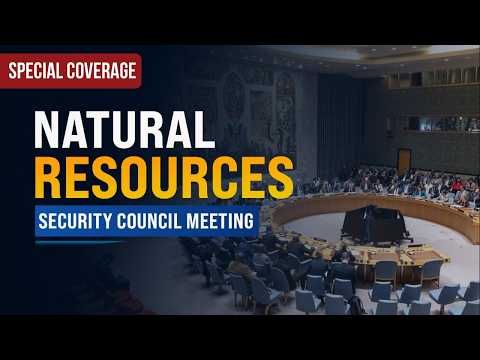
The United Nations Security Council held an open debate on critical minerals and conflict that centered on how to convert resource wealth into local development rather than drivers of violence. Delegations called for stronger governance, enforceable traceability across supply chains, and investment in national capacity and regional cooperation.
A U.N. representative framed the discussion around four priorities: justice for resource‑endowed countries, prevention of illicit flows, peaceful resolution of resource disputes, and climate‑sensitive prevention. “Countries and communities must benefit first and most from the resources in their own backyard,” the representative said, urging strengthened national institutions to negotiate equitable mining agreements and expand domestic processing.
Denmark’s representative urged fuller use of Security Council tools — including sanctions, expert panels and reporting mandates — to disrupt illicit financial flows that sustain armed groups. “It is time to make the expectation and weaponization of natural resources more costly than their responsible and peaceful management,” the representative said, arguing for technical assistance and traceability rather than additional bureaucracy.
Liberia described national reforms and international mechanisms that helped turn extractive wealth into recovery, calling for five concrete actions including treating resource governance as conflict prevention and building an interoperable global traceability architecture. A regional representative for the Great Lakes highlighted a certification mechanism for tin, tantalum, tungsten and gold and reported more than 33,000 certificates issued in the Democratic Republic of the Congo, saying credible regional traceability systems can redirect benefits to communities.
Several delegations stressed that local value addition — processing, refining and manufacturing — is essential to change incentives and broaden the economic benefits of mining. A senior speaker noted Africa holds a significant share of critical minerals and said moving up the value chain would create jobs, strengthen state capacity, and make extraction easier to tax and regulate.
The United States highlighted recent diplomacy and infrastructure projects intended to secure supply chains and promote investment, citing a strategic partnership and the Lobito Corridor project to connect the DRC to Atlantic ports. The United Kingdom and others noted recent sanctions targeting illicit gold networks and urged coherent implementation of existing frameworks such as the Kimberley Process and the Extractive Industries Transparency Initiative (EITI).
Speakers repeatedly warned that illicit exploitation and opaque trade routes finance armed groups and prolong wars. Delegations urged coordinated action among producing, transit and consuming states, regional organizations and financial institutions to close enforcement gaps and to pair market‑information systems with commitments on benefit sharing.
The debate closed with broad agreement on the need for international cooperation that respects national sovereignty while supporting national capacities for transparency and value addition. Delegations invited the U.N. secretary‑general to consider cross‑pillar frameworks that link peace, development and human rights into a single approach to natural resource governance.
The Security Council recorded no formal vote during the debate. The presidency said follow‑up discussions and proposals for practical cooperation would be taken forward by member states and regional partners.