Get Full Government Meeting Transcripts, Videos, & Alerts Forever!
Get email alerts on the Land Use topic
No spam. Unsubscribe anytime.
Troy planning commission fast-tracks service‑station code change after hours of UDC public comment
Summary
After a staff presentation on the Unified Development Code and an extended public‑comment period focused on data centers, the planning commission voted to recommend an emergency text amendment for service stations and declined to hold an optional planning hearing on that amendment.
The Troy Planning Commission on July 22 reviewed a draft Unified Development Code (UDC), heard more than a dozen public comments—many urging a moratorium or ban on data centers—and voted to recommend an emergency text amendment for service‑station rules to city council while deciding not to hold an optional planning‑level public hearing on that specific amendment.
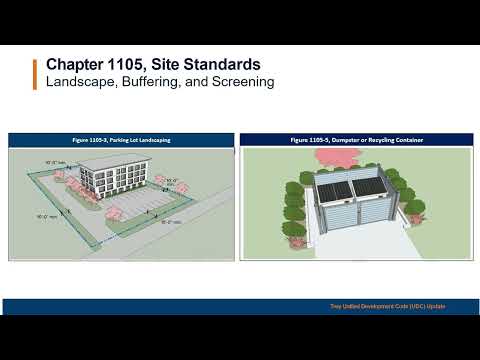
Staff presented the UDC as a consolidated code combining zoning, subdivision, sign and fence regulations into a single document and described process milestones, visuals and usability features developed from more than 680 public survey responses and stakeholder meetings. The presentation outlined major changes including consolidated district classifications (residential districts reduced from seven to four), simplified use tables, a 25% reduction in parking requirements for commercial and industrial development, and revised site standards such as setback graphics, lighting and noise charts.
The presentation addressed several high‑profile topics that drew the largest public response. Staff confirmed data centers would be processed as planned developments (PDs) — a rezoning and PD review that typically begins with a preliminary plan, includes administrative review and moves to the planning commission and city council, with an anticipated four‑to‑six month timeline for the initial PD steps. Proposed use standards for data centers include 100‑foot minimum setbacks, 25‑foot buffer plantings, noise and vibration mitigation plans and required landscaping and screening. For fuel‑dispensing stations, staff recommended lowering the minimum associated building size from 50,000 square feet to 10,000 square feet when at least 51% of floor area is devoted to grocery or restaurant use, changes to canopy placement (move to rear yard where feasible) and additional dimensional and siting limits.
Public commenters largely focused on data centers. "I propose we implement a long‑term moratorium on data center development in Troy," said Madison Hickman, 3rd Ward councilman, who argued data centers deliver far fewer jobs per acre than manufacturing or logistics and urged more study of utility, water and long‑term land‑use impacts. Several residents called for outright bans; others urged mandatory public hearings or stronger environmental and decommissioning accountability. By contrast, representatives of the development community urged predictability and administrative flexibility. "Businesses and developers need a clear, efficient and consistent process to reduce risk and drive development," said Paul Oberdorfer of the Troy Development Council and Troy Area Chamber of Commerce.
The commission also heard a range of other public concerns: several speakers urged allowing tattoo studios as independent businesses rather than restricting them as accessory uses; multiple commenters asked the UDC to reconcile local rules about marijuana dispensaries and tobacco/vape shops following a voter initiative legalizing marijuana; and downtown homeowners raised worries about B3 mixed‑use language, the 180‑day discontinuance rule for nonconforming uses and potential impacts on accessory apartments.
After public comment, Commissioner Jordan (motioning) proposed separating the service‑station portion of the UDC for expedited consideration and asked the commission to recommend a text amendment to council to allow the moratorium on service stations to expire. The commission first voted to not hold an optional planning‑level public hearing on the service‑station text amendment; the motion was seconded and approved on roll call. The commission then voted to recommend that council adopt the service‑station language as an emergency measure so it could take effect as soon as allowed under local procedure. Both roll‑call votes were recorded as carried by the members present.
Staff said it will compile the public comments received at the meeting and submit a packet with responses vetted by StructurePoint and city consultants for the commission’s next review. The commission discussed scheduling and referenced a follow‑up review at an upcoming meeting in August.
Votes at a glance
- Motion to not hold an optional planning‑level public hearing on the proposed service‑station text amendment: approved (roll call; majority yes). - Motion to recommend that city council adopt the service‑station text amendment as an emergency measure so the moratorium could expire sooner: approved (roll call; majority yes).
What happens next
Staff will compile the comments and post the packet and responses; the commission will review that material at a subsequent meeting and forward any formal recommendations to city council. Any PD application for a data center would later be subject to the UDC’s PD process, administrative checks and required council public hearings when a rezoning is part of the application.