Get Full Government Meeting Transcripts, Videos, & Alerts Forever!
Get email alerts on the Parking Variance topic
No spam. Unsubscribe anytime.
Hillsboro zoning board approves parking variances to support Taber college's MJR building project
Summary
The Hillsboro Board of Zoning Appeals approved three parking variances for Taber College's MJR business and entrepreneurship center, allowing the school to count additional nonresidence parking within 500 feet, require the new lot before occupancy, and expand event parking counting to 900 feet (approved 4—1).
The Hillsboro Board of Zoning Appeals voted to approve three parking variances requested by Taber College for its planned MJR business and entrepreneurship center, a project that includes restoring the historic MJR building and adding an 82-space lot.
The action matters because it changes how the city will count nearby nonresidence parking spaces for large events and for a new academic building'potentially reducing the number of additional spaces the college must provide while adding a condition that the new lot be completed before an occupancy permit is issued.
Presenter representatives for Taber told the board they had three parts to the variance request. They said the fine arts center seats 971 people and, under the code'which requires one parking space per four occupants'would need 243 spaces. The presenter said adding the new 82-space lot would raise the counted nonresidence spaces within 500 feet to 255, "12 spaces more than the 243 required," and asked that those nonresidence spaces be allowed to count toward the requirement. "Currently, the fine arts center has a total capacity of 971 people," the presenter said.
The applicant also proposed an alternative for rare, large events: expanding the event parking radius to 900 feet. The presenter said that expansion would add about 100 additional nonresidence spaces and increase the counted total to roughly 343 spaces.
On the new MJR building, presenters said the submitted occupancy estimate is 459 people, which would yield a code requirement of about 184 spaces using the code's 40% factor. The applicant argued that most students live on campus (presenters gave figures in the mid-90s percent) and proposed a different counting approach'counting 100% of staff and only 4% of nonresidential students'which would drop the practical requirement to about 90 spaces, 82 of which would be provided in the new lot.
David Janssen, president of Taber, described the planned restoration and addition to the Mary J. Revere (MJR) building and said the campus population and event profile informed the parking plan. "It could kill the project," Janssen said when asked what would happen if a required variance were denied, arguing that strict application of the code left no feasible location for the additional parking.
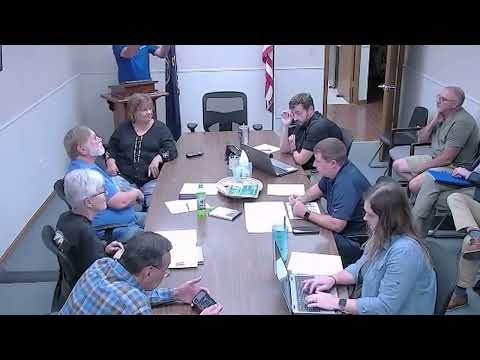
Board members pressed on the accuracy of the applicant's counts and the potential effect on neighborhood streets if overflow occurs. A board member reviewed Board of Zoning Appeals criteria and noted that a variance may be appropriate if strict enforcement creates an unnecessary hardship while staying within the spirit of the zoning ordinance. The board also discussed campus enforcement tools: Taber facilities staff described campus fines and a permit system used to discourage daytime violations.
Motions and votes: the board took separate votes on each part of the request. It approved variance request number one on a unanimous vote (motion moved and seconded on the record). It then approved variance number two with added language requiring that an occupancy permit not be issued until the new parking lot is finished; that motion also passed unanimously. On variance number three, to expand the event parking radius to 900 feet, the board approved the request by a 4—1 vote after clarifying that a yes vote would expand the counting radius even though members acknowledged the 500-foot solution likely met the current needs.
The board closed the public meeting portion of the hearing after questioning and proceeded to board and staff comments. Members and Taber representatives exchanged thanks; the board welcomed new appointee Tim Cassidy and noted that member Krista was departing.
The case is complete at the Board of Zoning Appeals level; the variances and the occupancy permit condition are now recorded in the board's action for BZAV2025-01.