Get Full Government Meeting Transcripts, Videos, & Alerts Forever!
Get email alerts on the Natural Resources Conflict topic
No spam. Unsubscribe anytime.
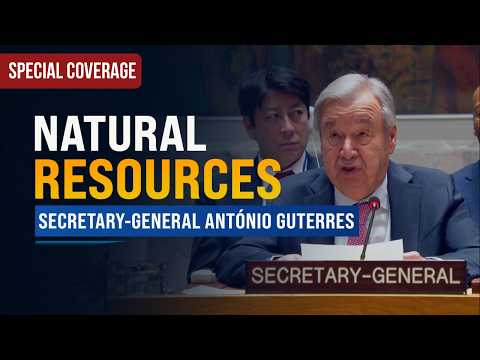
U.N. Secretary‑General Antonio Guterres urges action to stop illicit resource exploitation that fuels conflict
Summary
In an open Security Council debate, Secretary‑General Antonio Guterres said illicit extraction and trade in minerals and other natural resources are driving armed conflict and humanitarian harm. He outlined four priorities — justice, prevention, peaceful dispute settlement and climate‑aware prevention — for member states and U.N. bodies to pursue.
In an open Security Council debate, United Nations Secretary‑General Antonio Guterres said illicit extraction and trade in critical minerals and other natural resources are reshaping "the causes, dynamics, and outcomes of conflicts," and called on member states to act to prevent those revenues from fueling violence.
Guterres told the Council that surging global demand for "critical minerals such as lithium, cobalt, nickel, and rare earth elements" creates economic opportunities but also intense geopolitical competition that can strengthen armed and criminal actors. "All too often, revenues from illicit exploitation of natural resources are pushing peace out of reach," he said.
The Secretary‑General framed his remarks around four "urgent priorities." On justice, he urged that mineral development deliver "fair and sustainable outcomes" for producing countries and communities, and that value be retained through in‑country processing, stronger regulatory frameworks, and respect for environmental and human rights standards. He said U.N. entities, including the UN Environment Programme and the UN Economic Commission for Africa, are supporting national authorities in countries such as the Democratic Republic of the Congo, Mozambique, Uganda and Zambia with financing from the joint SDG Fund.
On prevention, Guterres urged closing regulatory and enforcement gaps across the full value chain — from extraction through transit and processing — and called for cooperation among producing, transit and consuming states, as well as stronger traceability and due diligence. He cited "last week's announcement that [the] European Union will ban the purchase, import, and transfer of gold from Sudan" as an example of measures aimed at preventing illicit resources from entering legitimate markets.
The third priority was the peaceful settlement of disputes. Guterres recommended the greater use of tools outlined in Chapter VI of the U.N. Charter — including good offices and mediation — when questions over access, ownership, territorial control or revenue sharing threaten prospects for peace.
His fourth priority urged that preventive and political efforts integrate climate and environmental analysis, noting that drought, flooding and ecosystem loss can reduce access to land and water, strain institutions and heighten tensions that may spark violence.
Drawing on recent reporting, he pointed to the eastern Democratic Republic of the Congo, where "armed groups have reaped the benefits of illegal mining and mineral smuggling," and to Sudan, where competition over gold and gum Arabic has contributed to atrocities and displacement. "Everywhere, the greatest burden falls on the least powerful, women and children, and communities displaced from the land that holds the wealth," he said.
Guterres commended panels of experts for documenting violations and tracing supply chains and called on Council members to use that evidence to inform policy and operational responses. He closed by urging Council members to "choose peace." The presiding officer thanked the Secretary‑General and gave the floor to the next speaker.