Get Full Government Meeting Transcripts, Videos, & Alerts Forever!
Get email alerts on the Stormwater And Local Flooding topic
No spam. Unsubscribe anytime.
Residents press Oak Bridal Colony developer and city over canal maintenance, drainage plans
Summary
At an Oak Hill neighborhood meeting, developer representatives described stormwater redesigns for the Oak Bridal Colony subdivision and an engineer said the plan will cut certain off-site flows roughly 93%; multiple residents urged the city to press Volusia County to repair canals and ditches they say are worsening flooding.
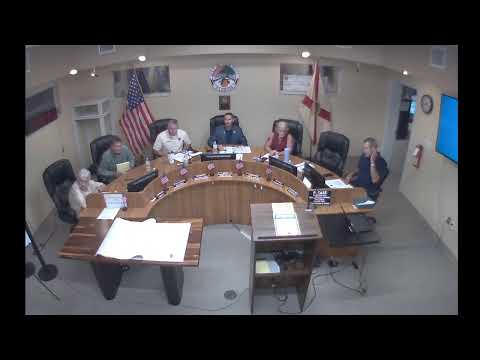
City of Oak Hill officials, the developer and scores of residents met to discuss the Oak Bridal Colony subdivision and persistent downstream flooding tied to local canals, with the developer and project engineer describing large stormwater controls and residents pushing the city to force county maintenance.
Joey Posey, the landowner's attorney, opened the meeting by describing the subdivision as a design-stage project that was master-approved in 2021 and has been revised to remove about 100 lots from the original plan. Posey said the developer is at the last design steps and emphasized the meeting was a dialogue, not a decision-making session.
Residents who live along the North/Bridal Road canal and adjacent ditches described long-standing erosion and recent increases in water levels they attribute to upstream changes. "Ain't nowhere for it to go except me in my house," said resident Anthony Jeffords, who told the commission the ditch bank in front of his property has repeatedly washed away and recently came close to entering his house. Tom Pence, who owns Indian Mount Fish Camp, said dredging costs have risen and that flows changed when nearby projects altered the canal's path.
The engineering team, led by Harry Newkirk of Newkirk Engineering, walked through how the subdivision's stormwater system will work under current state and water-management rules. Newkirk described a two-stage approach: dry retention areas sized across the site that percolate to soils, and wet detention ponds that receive overflow for larger events. He said the design includes control structures and pipes to distribute flows and to avoid pushing more water to downstream neighbors. "What we're doing up front is a 93% reduction in stormwater volume into that wetland," Newkirk said, and he added the design also lowers the peak rate in some locations by about 85%.
Residents pressed for guarantees. Commissioners and Posey said the developer will inspect and document problem locations and that Ben Bartlett from the project team offered to visit impacted properties: "Give me a list of those folks. Tell me where it's at. I'll make a point to check it out," Posey said. Engineers also described the regulatory and maintenance framework: state and water-district rules require operation-and-maintenance agreements and municipalities or HOAs commonly post bonds to ensure long-term upkeep.
Several speakers challenged the focus on on-site fixes alone and urged the city to pressure Volusia County, which owns many of the ditches and canals at issue, to perform long-delayed maintenance. Neil Bonds and other residents urged a combined strategy: gather documented complaints from every affected property, press the county, and consider bonding or special-benefit assessments to fund repairs. City staff and commissioners responded that some remedies (impact fees, benefit districts, development agreements) exist but are constrained by statute and by whether prior approvals are vested.
On technical questions, Newkirk said the team modeled a 100-year storm using 13 inches of rainfall for the locality and that designs now incorporate more site-level stormwater area (he cited a typical rule of roughly 30% of the site dedicated to stormwater in the current code examples he discussed). He warned that extremely rare storms (he cited a 30-inch multi-day event once discussed at the meeting) exceed what individual sites can reasonably be designed to hold and that system-wide solutions will be necessary for those extremes.
Commissioners and the developer encouraged residents to organize a consolidated set of documented impacts so the city and developer can jointly approach the county and other agencies. The developer and engineers offered to conduct on-site visits with residents and county representatives to identify specific fixes. No formal vote or permit decision was made; the meeting closed after the commission opened the floor to final comments and a motion to adjourn.
Next steps: the developer said staff will collect addresses of impacted properties for inspections, the engineer said he would contact county engineers about the North Canal, and commissioners said they would pursue coordinated follow-up with Volusia County and the developer.