Get Full Government Meeting Transcripts, Videos, & Alerts Forever!
Get email alerts on the Tax Increment Financing topic
No spam. Unsubscribe anytime.
Residents, school officials and trustees spar over proposed Northfield TIF; hearing set for Aug. 25
Summary
At a July 21 Committee of the Whole meeting, residents and school representatives pressed trustees for more data and a delay on a proposed Tax Increment Financing (TIF) district, while village staff defended TIF as the most viable revenue tool to address aging infrastructure. The board scheduled a public hearing for Aug. 25 and noted Sept. 22 as the earliest possible vote date.
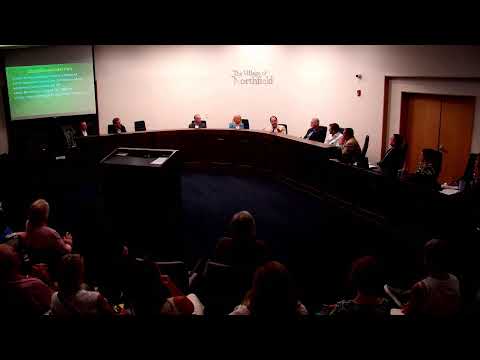
Residents, school‑district representatives and trustees spent the July 21 Northfield Committee of the Whole meeting debating a proposed Tax Increment Financing district that village staff says is needed to pay for local infrastructure and redevelopment.
The meeting opened with more than a dozen public comments sharply focused on the TIF. "The school district's position remains officially opposed to the TIF," said Charlie Pick, a Joint Review Board public member and District 29 school board representative, adding that his consultants did not find the statutory requirements to create a TIF had been met. Pick also highlighted a $15,000,000 "reimbursement fund" line in the redevelopment budget and said the plan did not include supporting documentation showing that figure would fully replace school revenues.
"These numbers are financially devastating for the operation of District 29," said Sam Tiedemann, a lifelong resident and data scientist, after presenting modeling that showed one 92‑unit project at 470 Central could produce an estimated $7 million to $9 million in tax revenue for District 29 over a 23‑year term if not captured by a TIF. Tiedemann warned the TIF as currently designed could lead to legal challenges unless the district can show blight or that development would not occur "but for" TIF assistance.
Village staff defended TIF as the best of limited options to generate funds without directly raising property taxes for residents. Patrick (village staff) listed needs inside the proposed boundaries — the former Mariano's site, library site work (about $2,000,000 in site work), Hap Road design costs, and roughly $7,500,000 in village infrastructure work — and described aging water mains with an estimated replacement need in the $105 million to $129 million range. He reviewed alternatives (special service area, property tax or sales tax rebates, Cook County 6b/7b programs and raising property taxes) and said many produce little or no net revenue for village infrastructure or would place a larger direct burden on residents or businesses.
Staff explained how a TIF captures "new growth" property tax levies in a defined area and redirects that increment to a special fund used for redevelopment projects or grants under public review. Patrick said the village could limit risks by requiring developer applications, independent gap analyses, redevelopment agreements approved in public meetings, and periodic reviews — including a proposed review at year 11 to consider early termination if goals have been met.
Trustees and commenters pushed for greater transparency and protections for taxing bodies. Beverly Smith, chair of the Northfield Caucus, read a five‑item consensus asking the village to delay the Aug. 25 public hearing by 60 days, conduct a resident survey, provide a detailed rationale for the district boundaries and inclusion of properties already undergoing development, publish 5‑ to 20‑year economic impact projections, and disclose SB Friedman’s consultant duties and compensation. Several speakers urged the board to memorialize protections in any ordinance — for example, regular reporting to affected taxing jurisdictions and a mechanism to offset or reimburse school capital costs if enrollments increase because of new housing.
The board confirmed the next Joint Review Board meeting is scheduled for Aug. 13 at 2 p.m.; the public hearing is on the calendar for Aug. 25 at 7 p.m.; and the earliest the village board could legally vote, as stated at the meeting, is Sept. 22. Patrick said presentation materials would be posted on the TIF webpage before noon the following day. The committee approved the May 26 minutes by voice vote and later moved to adjourn.
What happens next: the village will post the presentation materials and continue conversations with school and park districts; the Aug. 13 Joint Review Board meeting and the Aug. 25 public hearing are the next formal steps where drafts and proposed ordinance terms can be discussed publicly.