Get Full Government Meeting Transcripts, Videos, & Alerts Forever!
Get email alerts on the Federal Budget Reconciliation topic
No spam. Unsubscribe anytime.
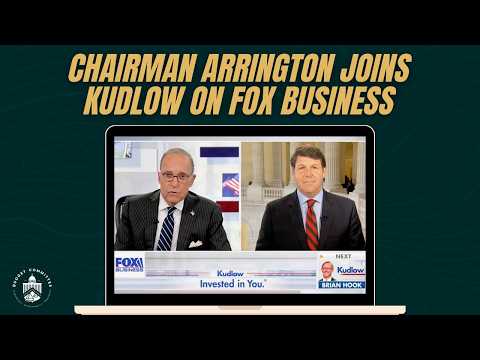
House Budget Committee chair Jody Arrington says reconciliation should prioritize troops and election safeguards
Summary
In an interview, House Budget Committee chair Jody Arrington urged swift emergency military funding and the "Save"/"Save America" election-integrity measures while warning pay-fors are politically sensitive and better handled in the Senate; he reiterated support for targeted tax changes for housing.
House Budget Committee chair Jody Arrington said in an interview that Republicans should move quickly to pass emergency military funding and election-integrity legislation while taking care not to jeopardize prior fiscal reforms.
"We passed historic tax cuts," Arrington said, and added that in the first reconciliation bill "we cut $2,500,000,000,000 in waste, fraud, and abuse, which was the 2nd largest spending cut in the history of The United States." He framed the next reconciliation effort as both a chance to support troops in conflict and to advance what he called the Save (or "Save America") Act to "infuse confidence for the American people in the electoral process."
Host Larry opened the interview by criticizing the proposed budget, saying it contained "no spending cuts and there are no tax cuts," and asked whether a third reconciliation bill could clear the Senate without pay-fors. "Can you get that without pay fors? Without offsetting budget cuts?" he asked.
Arrington replied that, in principle, "we should have pay fors for everything," but said politically it can be safer to develop offsets in the Senate to avoid exposing House reforms to an amendment-driven process. "I think the pay fors are better done in the Senate so that they don't step on a landmine and open up ... the risk of losing some of the savings and reforms that we put in the 1st reconciliation bill," he said, arguing that opening the Senate amendment process could allow some Republicans to break rank and undo reforms.
On priorities, Arrington emphasized urgency for defense spending: "This is emergency spending ... Our troops are counting on us. There is a need for speed," and accused Democrats of previously impeding legislation, saying they had "blocked the NDAA" and "blocked FISA." He framed the Save Act as "the big opportunity for us" and said election integrity is central to maintaining a functioning democracy.
Larry urged including middle-class tax measures, suggesting capital-gains indexing or higher exemptions for home sales would be "pro growth" and broaden Republican appeal. Arrington agreed such housing-related tax tools could work, noting possible "capital gains tax breaks for selling to first-time homeowners" and temporary expensing "for housing structures" for two or three years.
Arrington cautioned that Senate Finance Committee dynamics matter and suggested leaving detailed pay-for negotiations to senators he named by role: "Let Ron Johnson ... Rick Scott and Mike Lee, along with Thune, work through how they can thread the needle and not do any harm first and foremost, and then lay out some savings to offset the bill."
The interview concluded without any formal commitments or legislative action; Arrington and the host agreed on general priorities but did not specify concrete offsets or a procedural timeline for enactment.