Get Full Government Meeting Transcripts, Videos, & Alerts Forever!
Get email alerts on the Tax Collections topic
No spam. Unsubscribe anytime.
Tennessee Department of Revenue explains collections process, penalties and TenTap steps in taxpayer webinar
Summary
Department officials urged taxpayers to file required returns (including ‘no-sales’ returns), maintain master TenTap access, and use TenTap to request penalty waivers or payment plans; they outlined NOPA, final demand and levy/lien steps and said interest cannot be waived.
Tennessee Department of Revenue officials used a taxpayer webinar to walk business owners through the state’s collections process, urging attendees to file required returns, maintain master TenTap access and contact the department early to resolve discrepancies rather than pay estimated assessments.
Billy Trout, with the Tennessee Department of Revenue’s taxpayer and education section, said taxpayers should ‘‘file the return and pay what is owed’’ rather than simply paying an estimated notice. He warned that an estimated Notice of Proposed Assessment (NOPA) is often larger than the tax ultimately owed and that filing the missing return typically resolves the discrepancy.
Katie Julian, the webinar host, summarized the collections timeline: penalties and interest begin accruing the first day a return or payment is late; a NOPA is typically issued about 30 days after a delinquent or missing return; if unresolved, the department issues a final demand letter and creates a collections case; failure to respond to the final demand within 10 days may lead to levy or lien actions. "If you get this letter, call us," Julian said, urging taxpayers to check TenTap and keep contact information current.
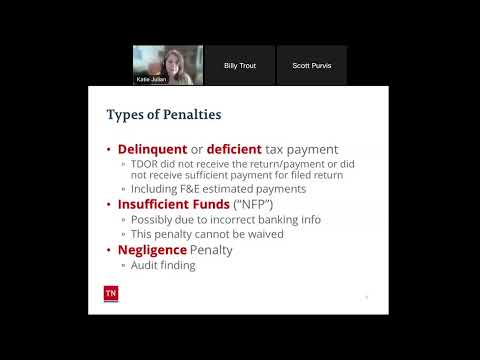
Julian described the penalty schedule presented in the webinar: a 5% penalty for days 1–30 after delinquency, rising incrementally to a maximum of 25% after 120 days. She said the department’s posted interest rate at the time of the webinar was 8% (subject to annual review around June 30) and that payment-plan interest was 11%. She added that penalties may be waived for reasonable cause through a TenTap petition but that interest cannot be waived.
Scott Purvis of the department’s collections division explained that NOPAs are period-specific (for example, separate notices for each month in sales tax reporting) and that final demand letters can consolidate multiple periods and tax accounts. He advised taxpayers who receive multiple notices to log in to TenTap, confirm which reporting periods are missing, and file the required returns as the first step toward resolution.
Panelists reviewed available remedies: file the missing return, pay the balance on TenTap, set up a payment plan (only a TenTap master account holder may request plans and all returns must be filed before a plan is approved), or request an informal conference within 30 days of a NOPA to dispute an assessment. The presenters also explained remedies for over-collection: levied or otherwise over-collected funds can be refunded via a TenTap claim for refund, though processing takes several weeks.
The webinar included a demonstration of the department’s online resources (tn.gov/revenue), the Revenue Help articles, tax manuals, the taxpayer-education webinar archive and a new-business workshop. Speakers reiterated that some taxes (for example, unemployment insurance and certain property assessments) are handled by other agencies, including the Tennessee Department of Labor and Workforce Development and local county offices.
The session closed with contact information for general taxpayer support (revenue.support@tn.gov; (615) 253-0600) and collections questions (revenue.collection@tn.gov; (615) 741-7071) and a reminder that the webinar recording and PDF will be posted on the department’s webinar archive.
Next steps: panelists encouraged taxpayers to verify TenTap master access for all tax types, file any missing returns immediately, and contact taxpayer services before notices escalate to collections.