Get Full Government Meeting Transcripts, Videos, & Alerts Forever!
Get email alerts on the Property Sale topic
No spam. Unsubscribe anytime.
Supervisors review legal steps to sell township property and consider preservation options for Darlington Inn
Summary
Staff outlined the statutory sale process under the Second Class Township Code and discussed how the board could use appraisals, minimum bids, easements or incentives to protect historic Darlington Inn; staff recommended consulting preservation groups before final sale decisions.
Township staff presented an overview of the statutory process for selling township-owned real property at the July 20, 2026 supervisors workshop, citing what the presentation described as "section 15 oh 3" of the Second Class Township Code. Staff said properties with value above $6,000 generally must be sold by competitive sale — via sealed bids or a public auction — after public advertisement, and the board may set minimum bids or reject offers below fair market value.
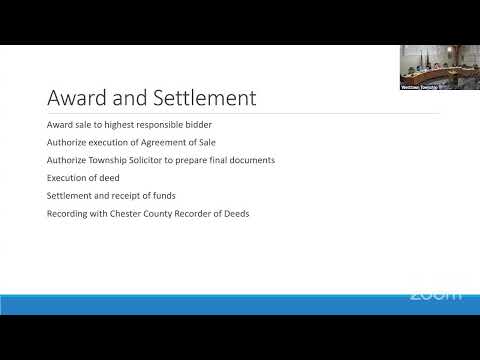
Staff emphasized steps the board would typically follow: declare the property surplus, authorize a qualified appraisal to establish fair-market value, decide whether to attach conditions (such as facade easements or deed restrictions) or offer incentives, advertise the sale publicly at least once before bid opening, award the sale at a public meeting, and require the buyer to pay the purchase price within 60 days of award. Staff also described that if no bids are received after required auctions, the township may proceed with other sale processes, including private sale subject to additional steps.
Why it matters: the board’s approach to conditions (for example, whether to record an easement before sale or allow a conditional easement after sale) will affect marketability and the property’s value. Staff noted that restrictive protections can materially lower the sale price and recommended consulting a preservation organization and the township solicitor when considering easements.
The presentation applied the process to the Darlington Inn, which staff identified as an example where the board might evaluate facade-easement options. Staff referenced a prior presentation from Jennifer Robinson of the Preservation Alliance and said consulting a third-party qualified preservation organization would help identify features to protect and to structure easement terms. Staff stressed that the extent of protections (front façade only, whole building, interior features) determines the financial impact and whether an updated appraisal or appraisal analysis would be needed.
Public commenters raised related points: one asked whether agenda materials for the next workshop were posted as required under the Sunshine Act; staff acknowledged the concern and said they would create an appropriate web page (Prevelli Preserve was discussed as a page example). Another commenter noted that buyers of historic properties sometimes receive tax abatements and urged the board to seek preservation-minded purchasers.
Next steps: staff recommended the board declare any specific property surplus and authorize appraisal work before setting minimum bids or sale method. The board did not take final action at the workshop.