Get Full Government Meeting Transcripts, Videos, & Alerts Forever!
Get email alerts on the Residential Parking topic
No spam. Unsubscribe anytime.
Westtown planners debate loosening residential parking rules, commercial‑vehicle limits
Summary
At a July 22 meeting the Westtown Township Planning Commission discussed draft zoning amendments that would alter front‑yard parking setbacks, clarify use of pervious paving and set size/weight limits for commercial vehicles parked in residential driveways; staff will consult police and emergency services before returning a final draft.
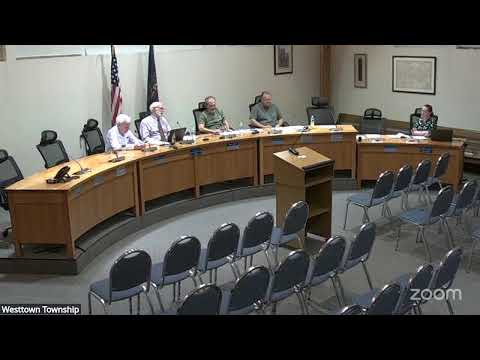
At its July 22 meeting the Westtown Township Planning Commission examined proposed amendments to the zoning code that would relax some residential parking limits and clarify rules about pervious parking surfaces and commercial vehicles.
Miss Carter, planning staff, summarized the draft and said the goal was to address resident concerns while avoiding a cascade of zoning changes. "The parking shall be provided on dust‑free all‑weather surface," she said, and noted that the draft would explicitly allow some pervious materials but require township‑engineer review under Chapter 144 (stormwater management). "Anytime you want to use pervious pavers, it's subject to approval by the township engineer, so you do have to provide an engineering plan," Miss Carter said.
Staff presented a table of vehicle classes and proposed limiting permitted driveway parking initially to light‑duty commercial vehicles, with the commission weighing whether to allow class‑3 (medium‑duty) vehicles in some cases. A committee member noted that class‑3 vehicles can approach roughly 14,000 pounds and warned heavier axle loads increase pavement wear. "If you resurface your driveway, you don't really have to apply for a permit with the township," Miss Carter added; pavement base, she said, controls long‑term durability.
Several commissioners and residents debated how to measure the front‑yard prohibition and whether to base it on the 'ultimate' right‑of‑way width (examples cited in the packet: local roads 50 ft, minor roads 60 ft, collectors 80 ft) or a simpler curb‑oriented rule. Resident Ted Arm urged a straightforward rule to help residents and enforcement: "Make the ordinance say nothing within 4 feet of the curb," he said, arguing a fixed distance would be easier to understand than fractional setbacks tied to right‑of‑way math.
Commissioners also discussed overnight parking enforcement and whether a blanket 2 a.m.–8 a.m. rule remains appropriate; staff reported most overnight citations arise from complaints and stressed the need for posted signage to enable enforcement. Several commissioners recommended targeted, road‑by‑road signage and promised to consult police and emergency‑services staff on safety and staffing implications before drafting final language.
The commission did not vote on ordinance language. Staff left the meeting with direction to gather technical guidance from the police chief and the emergency‑services coordinator, and to return with clarified draft language and engineering guidance on pervious surfaces and driveway design.
The commission moved on without adopting the ordinance; no formal vote on the zoning changes took place at the July 22 meeting.