Get Full Government Meeting Transcripts, Videos, & Alerts Forever!
Get email alerts on the Land Use Rezoning topic
No spam. Unsubscribe anytime.
Keystone Heights council approves land-use change and rezoning for 200 NE Commercial Circle over planning-board objection
Summary
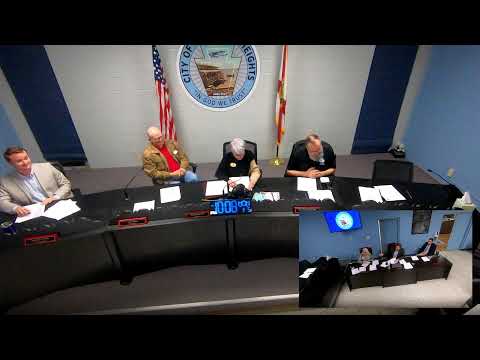
After a contested public hearing, the City Council on Jan. 5 approved a future land-use map amendment and rezoning that will allow light-industrial use at 200 NE Commercial Circle despite a 4–1 Planning & Zoning recommendation against the change, citing concerns about spot zoning.
The Keystone Heights City Council voted to change the future land-use designation and to rezone a 2.72-acre parcel at 200 Northeast Commercial Circle, approving ordinances that convert the site from commercial to light industrial and reclassify the zoning from general commercial to industrial.
Staff presented the proposal as a way to revive a long-vacant property with existing large metal buildings ill-suited to conventional retail, and said the requested classification would permit enclosed, light-industrial activities compatible with the surrounding mix of warehouse and commercial uses. Planning staff (Miss Lee) told the council that staff recommends approval because the change is consistent with the city's comprehensive-plan policies for light-industrial redevelopment and would help put a vacant building back into productive use.
The Planning & Zoning Board recommended denial at its September meeting by a 4–1 vote. At the council hearing, the Planning & Zoning chair's representative said the board's primary concern was spot zoning: applying a nonconforming land-use change to a single parcel without a buffer or adjacent transition, which can undermine predictability for neighbors. "Our decision was based on concerns regarding spot zoning," the speaker said, urging the council to document reasons if it chose to diverge from the board's recommendation.
Several council members acknowledged competing priorities. One councilmember urged caution about unintended uses that could follow rezoning, while another stressed the economic argument for reusing a 13,000- to 19,000-square-foot industrial-style building that has sat vacant for years. Council discussion weighed the town's desire for new jobs and reuse against neighborhood compatibility.
After public comment and council debate, the council approved the future-land-use ordinance (Ordinance 2026-615) by voice vote and then approved the companion rezoning ordinance (Ordinance 2026-616). The ordinances were read by title at the meeting and carried forward as adopted. Council members voting in favor cited potential economic development and the constrained physical layout of the existing structures as factors favoring light-industrial reuse; those opposed emphasized the planning-board's spot-zoning concerns and urged tighter use controls going forward.
The council instructed staff to ensure the change is implemented under the comprehensive-plan policies that limit industrial activity to enclosed, low-exterior-impact uses, and to report back if additional regulatory clarifications are needed. The ordinances become effective per the dates stated in the adopted texts. The council also discussed whether to review specific permitted uses in the city's zoning code to avoid unintended future conversions and to consider whether some industrial uses should require conditional approval.
Votes at a glance - Ordinance 2026-615 (future land-use map amendment for 200 NE Commercial Circle): approved (council vote; motion carried). - Ordinance 2026-616 (rezoning from general commercial to industrial for 200 NE Commercial Circle): approved (council vote; motion carried).
What happens next: Staff will implement the map and zoning changes and will follow up with any required administrative steps to align permitted uses with the comprehensive-plan language; council members asked staff to flag any code cleanups needed to prevent uses the council did not intend.