Get Full Government Meeting Transcripts, Videos, & Alerts Forever!
Get email alerts on the Planning Code Updates topic
No spam. Unsubscribe anytime.
Gladstone planning commission reviews code updates to implement recent state housing laws
Summary
At a work session on April 21, Gladstone planning staff outlined proposed municipal code changes to comply with multiple new Oregon housing laws, including allowances for residential treatment homes, expanded middle housing rules, tighter timelines for reviews, and limits on local notice and some traffic-related requirements. Commissioners asked staff to explore SDC/incentive options and clarify definitions before council hearings.
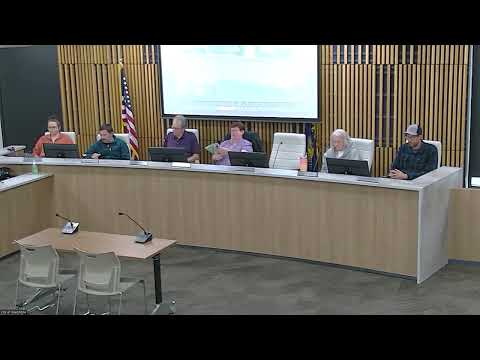
Gladstone — The Gladstone Planning Commission on April 21 held a work session on draft municipal code amendments intended to bring the city into compliance with several recently passed Oregon housing laws and related state rules. Planning staff summarized provisions that change where certain residential uses may locate, how middle housing is reviewed, and what local processes the city may no longer impose.
Planning staff told the commission that House Bill 2005 (2025) treats residential treatment facilities and residential treatment homes — including adult foster care and similar licensed residences — as housing that may be permitted on lands zoned residential, commercial or employment, and within 250 feet of residential on some industrial parcels. “The state looks at it as housing,” staff said, noting that Clackamas County still enforces health and safety requirements and may require a change-of-use permit and a facility license from the state licensing agency.
Staff also outlined changes from House Bill 2138 that affect middle housing (duplexes, triplexes, quadplexes, townhouses and cottage clusters). Under the updates, an existing single-family dwelling or ADU can count as one of the units in a new middle-housing project; cities must allow concurrent review of partition and middle-housing land-division applications; and the state limits when a city can require a traffic impact analysis for projects of 12 units or fewer. “You can now have an existing single unit dwelling, ADU, or duplex, and then those dwelling units count as one of your units of middle housing,” planning staff said.
Commissioners emphasized the practical effects of those changes. Several members said they are concerned that removing routine traffic impact analyses for projects of 12 units or fewer could leave neighborhoods without needed street or safety improvements. “That's really stupid,” one commissioner said during the discussion, later clarifying the remark as frustration about taking away a local tool to address measurable impacts. Planning staff replied that state law sets the threshold and suggested the commission consider policy tools such as incentives or SDC (system development charge) adjustments to address impacts.
The staff presentation also covered Senate Bill 974 and subsequent refinements (referred to in the presentation as changes captured in a related bill), which shift more residential reviews to staff-level administrative, clear-and-objective processes and narrow public notice (staff said the proposed notice radius would be reduced to roughly 100 feet in some cases and appeals may be limited to the applicant for specified residential development applications). Staff warned commissioners that some statutory provisions are effective immediately, while others carry sunset dates and refinements.
The commission reviewed SB 1537’s Housing Accountability and Production Office (HAPO) framework, which sets aspirational housing production goals for cities and mandates certain adjustments to local standards when projects meet density thresholds. Staff said Gladstone’s HAPO production goal is under 100 units for the tracked period (staff said the number is about 79 units for the reporting window but noted the city would verify the precise figure in materials to the council) and described examples of mandatory adjustments — reductions for parking minimums, landscaping, setbacks, and allowable modifications to façade or window-area requirements for certain projects.
On non-housing topics tied to the packet, staff proposed replacing the word “church” in city code with a broader term such as “religious institution,” “places of worship,” or a definition that captures tax‑exempt, community‑gathering organizations (to ensure nonprofit uses such as the Adult & Teen Challenge facility are correctly categorized). Commissioners expressed mixed preferences but broadly supported a definition tied to tax-exempt status and asked staff to draft language that would capture community-based gathering uses while remaining administrable.
Separately, the commission discussed a council referral on electronic message center signs after a facilities representative asked to replace an existing static sign at Kratzberger with an electronic reader board. Staff reviewed other city codes (Sherwood and Hillsborough were cited as examples) and proposed limiting eligibility (for example, to public schools or other narrowly defined institutions), setting distance buffers from residences, specifying maximum change intervals, banning flashing/animation, and tightening brightness limits (staff referenced an example that reduces a maximum of 8,000 nits to 1,000 nits between dusk and dawn).
Next steps: staff said they will research whether the city can design SDC or incentive programs tied to voluntary traffic studies, draft a revised definition for religious or community gathering uses that links to tax‑exempt status, and seek a traffic‑safety perspective (including the police chief’s input) on electronic sign timing and brightness. Staff plans to bring the refined code package to the City Council for public hearings on June 9.