Get Full Government Meeting Transcripts, Videos, & Alerts Forever!
Get email alerts on the Adaptive Management topic
No spam. Unsubscribe anytime.
Forestry staff outlines adaptive-management plan for HCP and FMP, flags monitoring and funding trade-offs
Summary
State forestry staff described an adaptive-management plan for the Habitat Conservation Plan and Forest Management Plan that emphasizes monitoring, triggers for change and reporting, and warned that limited funding and mismatched legislative KPMs could constrain implementation.
Presenter outlined the Habitat Conservation Plan’s adaptive-management approach, saying “the HCP notes that the conservation strategy is based on the best scientific information available currently, but it's expected that that will change over time.” The presenter said monitoring will track effectiveness and that the HCP identifies specific triggers that would prompt evaluation and potential changes in operations, implementation plans or policy.
Why it matters: The HCP carries legally binding monitoring obligations to federal wildlife services and requires formal amendment and a NEPA review for large changes. Staff told the advisory group the HCP’s monitoring and the FMP’s goals will be used in different ways: some metrics feed legal HCP obligations while others are meant as board-level performance measures to help prioritize management decisions.
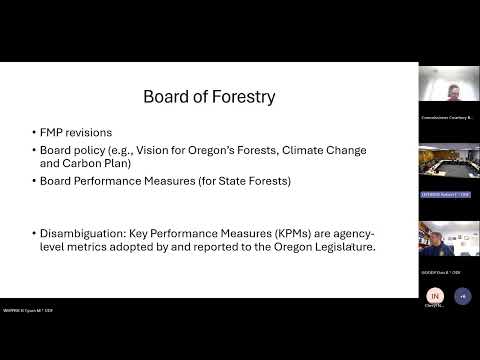
The presentation and subsequent discussion focused on three practical tensions: 1) which metrics to publish and how often, 2) how board-level Key Performance Measures (KPMs) relate to FMP goals, and 3) funding and capacity for monitoring. A participant explained legislative KPMs are tied to general‑fund investments and “since there's no general fund allocated to state forests, the agency mistakenly put those in as KPMs for state forests,” which can leave KPMs mismatched to forest management realities. Staff said board performance metrics are intended to be a smaller, flexible set that the board can use to evaluate FMP effectiveness.
On reporting cadence, staff described annual, five‑year and 10‑year reporting linked to HCP and FMP monitoring and said some components — acres, volume, stand management and roads — are amenable to annual reporting while others require longer time frames. Staff suggested an online dashboard to present these metrics publicly rather than another annual printed report.
Funding and capacity emerged as a constraint. One speaker said an estimated “about 2,000,000 a year” is committed under the HCP for species‑specific monitoring; staff and participants also discussed limits on department capacity, past cuts to adaptive-management and monitoring programs, and the need to seek collaborators and grant funding (for example with OSU and regional research partners) to address gaps.
Board role and accountability: Staff described multiple levers the Board of Forestry can use — approving or reopening the FMP, adopting board performance measures, and issuing policy — but several participants said those levers do not translate directly into statutory control over harvest levels. One participant observed the FMP is law and that “legal action can be taken” if plan requirements are not met, while another stressed that non‑HCP accountability often rests with the governor’s office under current governance arrangements.
Next steps: Staff offered to share draft performance‑measure components from a March board presentation and to circulate a canned overview presentation about department work. The charter subgroup will meet (first in July, second in early September) and planners will schedule a mid‑September meeting to prepare for October.