Get Full Government Meeting Transcripts, Videos, & Alerts Forever!
Get email alerts on the Economic Development topic
No spam. Unsubscribe anytime.
Governor presents Prosperity Council recommendations, says she will work with legislature on tax and competitiveness measures
Summary
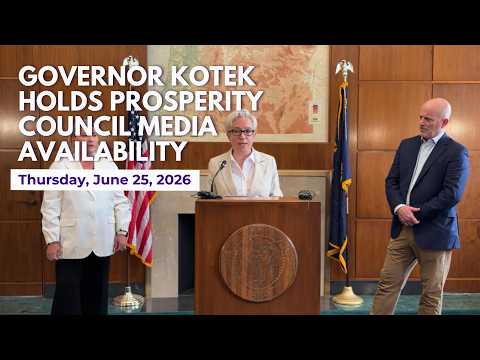
At a press event, the governor praised the Oregon Prosperity Council’s report as a guide for refining the state’s Prosperity Roadmap and said she will collaborate with legislative leaders on near-term tax proposals, climate alignment and workforce strategies; she emphasized analysis and coalition-building before committing to changes.
The governor unveiled recommendations from the Oregon Prosperity Council on the state’s economic strategy and said she will use the report to refine the state’s Prosperity Roadmap while working with lawmakers to decide which items to advance.
The governor thanked the council, its co-chairs and Oregonians who participated in roundtables and surveys, and framed the recommendations as a disciplined starting point for action. She said Oregon has made measurable progress on homelessness and housing, noting that the state “has unlocked more than 50,000 new housing units” since she took office, and pointed to expanded mental-health and workforce services as part of the foundation for future growth.
Pressed on four short-term tax recommendations that the Legislative Fiscal Office and Legislative Revenue Office appear to estimate would cost about $150,000,000 a year, Nigel Jake of the Oregon Journalism Project asked whether she would back the changes as a signal that Oregon is open for business. The governor replied, “I wouldn’t call them cuts,” and said the items could be structured to be revenue neutral as part of a broader package. She added that she will be “talking with legislators” and that any final approach will require analysis to ensure core services such as schools and health care remain funded.
When asked how the council reflected the lived experience of rural small businesses, a council representative listed specific agricultural participants who joined the process—David Booth (Tillamook), Lois Cho (Cho Wines) and Laura Nammis (Nammis Farms)—and said listening sessions were held in Bend, Redmond, Pendleton and in counties including Douglas, Clatsop and Columbia. The governor said the council heard from businesses of various sizes and from workers, and stressed the need to align workforce development so Oregonians can access good jobs.
On climate policy, the governor said Oregon’s current program will meet greenhouse-gas reduction goals but may not make the state as competitive with Washington and California. Asked whether changes such as a market-based cap-and-invest approach could be advanced by executive action or would require the legislature, she said structural changes to an agency’s mission or a large industrial-site readiness investment (she referenced a $250,000,000 figure as an example of an item that would need legislative support) would require lawmakers’ approval, while other actions could be folded into the budget or implemented administratively where lawful.
The governor also discussed higher education funding, saying she supports stronger postsecondary institutions and wants to understand what a West Coast comparator goal would look like and how it would be paid for before proposing specific funding changes.
She repeatedly emphasized process: refining the roadmap, identifying which recommendations to advance, who would lead implementation and establishing timelines. “I choose action,” she said, summarizing her approach to moving recommendations from the council forward.
No formal votes or legislative commitments were made at the event; the governor said next steps include further analysis, coalition-building with legislative champions and budgeting work ahead of the next session.