Get Full Government Meeting Transcripts, Videos, & Alerts Forever!
Get email alerts on the Cra Grant Guidance topic
No spam. Unsubscribe anytime.
Palatka advisory board presses for clearer CRA grant rules, votes to treat four Saint Johns applications as one
Summary
At its July 22 meeting the Palatka Tax Increment Fund Advisory Board urged staff to codify application guidance for the CRA building‑improvement grant, heard applicants’ concerns about inconsistent direction, and voted to treat four contiguous Saint Johns Avenue applications as a single project before forwarding recommendations to the CRA board.
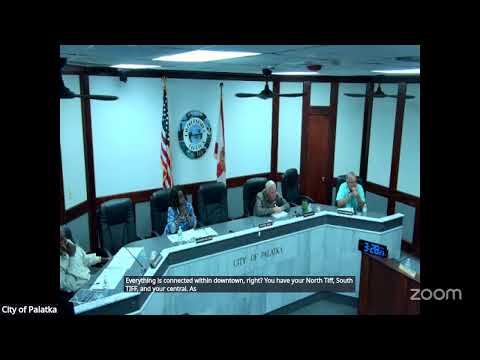
The Palatka Tax Increment Fund Advisory Board on July 22 pressed city staff for clearer, written rules for the Community Redevelopment Agency’s (CRA) building‑improvement grant program and voted to treat four submitted applications for contiguous addresses on Saint Johns Avenue as one project for scoring and recommendation purposes.
During public comment, Gabrielle Gunn, who identified herself as representing applicants for Bexhillon Properties, said staff turnover and inconsistent responses left applicants uncertain about the application process. "It's been unclear and I haven't been able to receive a straightforward answer, regarding the specific application process for these specific types of projects," Gunn said, asking for a written policy that clarifies whether applications are evaluated by parcel, address or business owner.
City counsel and staff told the board that the advisory committee reviews applications and makes recommendations to the CRA board, but that the governing rules for handling situations such as multiple applications for one building are not codified. The city attorney told the group there is "not a clear guideline on that particular issue" and that research showed "no enabling legislation" or formal resolution establishing written processes for the committee.
Board members expressed frustration that prior recommendations had not been acted on fully by the CRA. One member asked for feedback when board recommendations are not adopted so volunteers understand what to change next time. City staff said they are drafting an interlocal agreement and will add language to the program guidelines to clarify the committee's advisory role and the procedure for handling unusual application configurations.
The advisory board then reviewed and scored a slate of building‑improvement applications. Members evaluated each applicant on four factors required by the program: urgency of rehabilitation, redevelopment impact, alignment with program goals and applicant financial capacity. Several applicants spoke to the board about specific projects and answered questions about code compliance, contractor licensing and prior application history.
At issue for several contiguous Saint Johns Avenue addresses — submitted as four separate applications for one largely contiguous parcel — the board debated whether to treat them individually or as a single project. "I make a motion that we decide today, if possible, that we look at these as one application," a board member said; another member seconded the motion. The chair called for a vote and declared the motion carried. The board recorded the motion as a recommendation that staff add procedural language to the guidelines and forward the recommendation to the CRA board for final action.
Staff clarified several program mechanics: a bank letter is acceptable evidence that an applicant has the required matching funds, the reimbursement cap under the program is $25,000 per qualifying project if the reimbursement package meets the program’s requirements, and each TIF district (north, central, south) has its own revenue pool and eligible grant allocation. Staff also said unspent funds in a district remain available for future cycles and that financial reports by GL account are provided at CRA meetings.
Nicole Lehi, identified in the meeting as the CRA coordinator, and other staff said they will compile scores and notes and return the advisory board’s recommendations to the CRA board; staff told members the next CRA board meeting is scheduled for August 24, 2026. The advisory board adjourned after directing staff to formalize guidance and follow up on the items discussed.
What’s next: Staff will finalize scoring, add recommended language to grant guidelines addressing multi‑address submissions and acceptable financial documentation, and present the advisory board’s recommendations to the CRA board on Aug. 24, 2026.