Get Full Government Meeting Transcripts, Videos, & Alerts Forever!
Get email alerts on the Economic Development topic
No spam. Unsubscribe anytime.
Prosperity Council delivers 10 recommendations to the governor, urges tax, permitting and site‑readiness reforms
Summary
The Prosperity Council presented a 10‑item report to the governor after more than 60 statewide listening sessions, urging near‑term tax changes, a permitting 'shot clock,' a $250 million site‑readiness fund and a coordinated talent‑development cabinet.
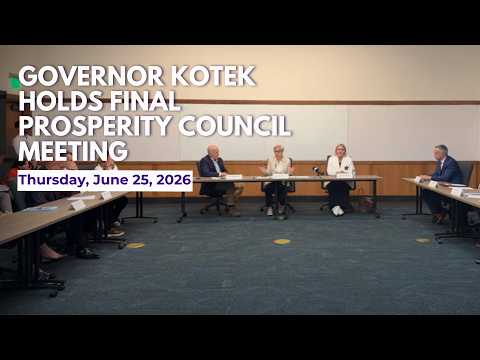
The Prosperity Council onstage presented its top 10 recommendations to the governor, urging changes to tax policy, permitting and regulatory practices and a $250 million biennial site‑readiness fund to spur business expansion in Oregon.
Co‑chair Renee James, who introduced the council and its members, said the recommendations were grounded in broad public input: "We had over 60 listening sessions across the state," she said, and the council sought to reflect what "regular Oregonians" said would help the state’s economy grow.
The council asked the governor to consider four near‑term tax changes: expand R&D tax credit eligibility for small and medium businesses; revise estate tax provisions to ease intergenerational transfers of family businesses; raise the administrative threshold for the corporate activity tax in a revenue‑neutral way so very small businesses can reinvest; and reinstate Qualified Small Business Stock (QSBS) incentives to attract start‑up investment.
Beyond those items, the council recommended a comprehensive tax‑code review ahead of the 2029 SALT deadline to ensure Oregon’s tax framework remains competitive. "We are not currently up and down our income levels in the state serving Oregonians as well as we want to with our current tax code," James said, citing comparative data in the report.
On regulation, co‑chair Curtis urged a suite of reforms to cut regulatory duplication and speed permitting. He proposed a permitting "shot clock" (citing California’s 30/90‑day example) and recommended a 20% reduction in the state’s regulatory count to remove outdated or duplicative rules. Curtis also recommended that lawmakers consider replacing the current CPP climate approach with a cap‑and‑invest system to improve alignment with other states and increase tradable credit options for businesses.
The council recommended state action to increase industrial land availability and to help local governments finance public‑works improvements that enable private expansions. Curtis said the council proposes a $250,000,000 site‑readiness investment, likely financed with lottery bonds, to be used as matching capital for infrastructure projects that unlock private investment.
Talent development and higher education were the third major pillar. James proposed forming a "cabinet of economic and talent development" to align workforce agencies and recommended revisiting higher‑education funding to stay competitive across the West Coast, saying Oregon currently funds postsecondary education at a low per‑student level.
The governor thanked the council for the work and for the statewide engagement, and said she will take the near‑term tax proposals to lawmakers and direct agencies to look for regulatory duplication and ways to implement fast‑track permitting reforms. She confirmed the council’s $250 million figure as a biennial target and said the administration will look for ways to advance site‑readiness funding in the upcoming budget and legislative cycle.
The meeting concluded with staff acknowledgements, including thanks to staff member Deepa Northwest for shepherding data and reports, and a short closing from Jordan Smith of Smith Properties.
What happens next: the governor said she will review appendix materials and coordinate with lawmakers as part of budget and legislative planning; no formal motions or votes were recorded during the session.