Get Full Government Meeting Transcripts, Videos, & Alerts Forever!
Get email alerts on the Rezoning topic
No spam. Unsubscribe anytime.
Ellsworth council tables Cameron Addition rezoning after residents and proponents debate
Summary
After hours of public comment for and against changing nine Cameron Addition lots from single-family (R-1) to two-family (R-2), the Ellsworth City Council voted to table the rezoning to Feb. 9 so members can review planning commission minutes and record details required under Title 17.
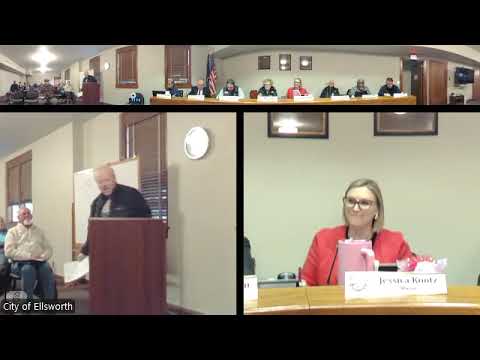
The Ellsworth City Council on Jan. 26 moved to table a proposed rezoning of Lots 1–6 and 8–10 in the Cameron Addition after extended public comment and council discussion.
The proposal would change nine lots from single-family residential (R-1) to two-family residential (R-2). Supporters said the change would add rental options and help recruit younger workers; opponents said the council must make location-specific findings required by Title 17 of the Ellsworth municipal code before approving a permanent zoning change.
"We respectfully request that the governing body clearly articulate specific written findings addressing each required zoning factor," said Terry Parks, speaking for nearby property owners. Parks said surrounding uses, neighborhood character and the public welfare must be applied to this location rather than relying on generalized housing need.
Anita Hoffeines, broker-owner of Hoffeines Real Estate, urged approval, saying the city lacks rental inventory and the change would help employers recruit. "This will give current citizens of Ellsworth and potential citizens more housing opportunities," Hoffeines said, noting her company manages dozens of units in the area.
Developer and property owner David Pyle told the council he has investors and has completed zoning steps; he described plans for duplexes and single-family homes aimed at the 18–30 age range. Pyle said utility infrastructure is in place for the lots and that the intended use included duplex dwellings in earlier plat materials.
City staff and the planning commission were discussed at length: some council members said the planning commission provided a thorough hearing and recommendation, while others said the governing body must independently document the required Title 17 findings before adopting an ordinance. One council member noted that the ordinance would require a supermajority to pass because of petition thresholds in the municipal code.
A motion to adopt the ordinance failed to move forward; instead, the council voted to table the item to the council's next meeting, set for Feb. 9, 2026, to allow review of the planning commission minutes, the original plat/deed materials and any additional documentation.
What happens next: Council requested clearer record material showing how the rezoning request satisfies each zoning factor in Title 17. The item will return to the council agenda on Feb. 9 for further action or potential adoption after the additional review.