Get Full Government Meeting Transcripts, Videos, & Alerts Forever!
Get email alerts on the Comprehensive Planning topic
No spam. Unsubscribe anytime.
Consultants tell Knoxville council 6,000 people engaged so far; plan highlights parks, housing and corridor trade-offs
Summary
Knoxville planners and consultants reported early outreach results for the city's comprehensive-plan update, saying more than 6,000 people have engaged and proposing "North Stars" that emphasize parks, complete neighborhoods and equitable investment; council members pressed for clarity on trade-offs, timeline and the meaning of a 15% "underutilized" land estimate.
At a city council workshop, Amy Brooks of Knoxville Knox County Planning introduced Interface Studio consultants who presented early findings from the first phase of the city's comprehensive-plan update and described next steps in the public outreach process. Scott Page of Interface Studio said the effort began in April and is roughly one-third complete.
"We're building a brand for the project," Page said, summarizing why the opening months focus on outreach and framing what a comprehensive plan can and cannot do. Stacy Chen of Interface Studio said the team has engaged more than 6,000 people through about 110 events, received roughly 1,800 survey responses and recorded more than 22,000 website views.
The consultants said public input and mapping work produced a set of draft goals, described to the council as "North Stars": safer walking and biking and better transit, balanced and sustainable growth, quality housing options across incomes and household sizes, complete neighborhoods, expanded parks and greenways, equitable investment and protection of history and cultural assets.
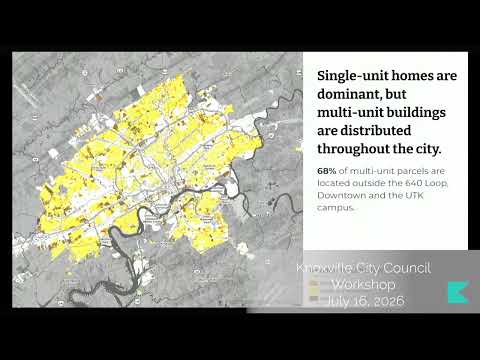
On housing, Page described a tightening market with few options between single-family homes and large apartment complexes. "It's difficult to build our way out of this problem quickly," he said, noting that some cost drivers (financing, materials) lie beyond city control while others (land use rules, soft costs) are local policy levers.
The presentation included a technical exercise to identify parcels that could be considered underutilized. Chen said the team's criteria exclude roads, parks, parcels in single-family-only zoning, steep slopes and floodplains, and then apply measures such as low lot coverage and land-value relationships. The consultants reported that this approach flags about 15% of parcel acreage as potentially underutilized.
Several council members pushed for more detail and context. Councilwoman Adams asked how the 1,800 survey responses are distributed geographically; the consultants showed a map of responses and said geographic coverage is "a good range of the city" but that gaps remain. A council member who identified a 9-month adoption timeline asked whether that schedule allows enough time for deep engagement; Page said timing varies by community but the team is watching both reach (numbers) and depth (quality of engagement).
Members also raised concern that residents may perceive the plan as only about change. One councilor requested that the team make trade-offs explicit so participants understand fiscal, infrastructure and environmental implications of different choices; Page said the next round of engagement will include more substantive discussion of policy implications and constraints.
The consultants described next steps: summer synthesis of engagement findings and draft goals, a fall wave of substantive outreach (September—November) to test draft ideas, and a draft plan to be circulated in early 2027. In the interim, planners will continue outreach at Market Square and on the project website "What's Next Knoxville."
The workshop ended with council members thanking the presenters; Vice Mayor Fugate adjourned the meeting.