Get Full Government Meeting Transcripts, Videos, & Alerts Forever!
Get email alerts on the Education Strategy topic
No spam. Unsubscribe anytime.
Spencer-Owen Community Schools workshop pinpoints professional development, curriculum and student mental health as top priorities
Summary
At a district workshop, participants working in small groups identified three strategic goal areas—professional development, curriculum (including science and civics), and student mental health—and were assigned to draft defining statements and 3–5 actionable strategies for each area for administrative follow-up.
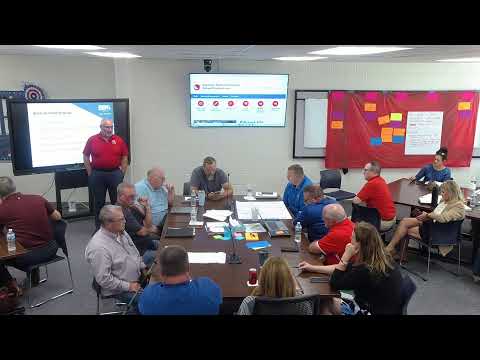
The facilitator led staff and other participants through a structured small-group exercise to identify strategic priorities for Spencer-Owen Community Schools. After grouping attendees into three teams and asking each table to post specific ideas on color-coded cards, group spokespeople summarized their discussions for the full room.
Groups raised a mix of curriculum and instruction issues and system-level supports. One group focused on strengthening Professional Learning Community (PLC) structures and districtwide professional development to better connect initiatives and improve outcomes for both struggling learners and the highest achievers. “We talked about the PLC structure, about professional development, and the need for increasing our connectedness between the initiatives,” a participant reported.
Another group said the corporation should revisit comprehension instruction after recent emphasis on the science of reading and consider a voluntary curriculum committee to limit pulling every teacher from classrooms for every change. “We talked about tier 1 effective instruction,” a participant said, and suggested channeling teacher energy into targeted, teacher-led curriculum work.
A third group highlighted communication and family engagement, recommending a single point person to manage messages on ParentSquare to reduce duplicate alerts, and urged flexibility for internships and work-based learning. The group also discussed early childhood intervention and balancing technology with hands-on learning. “ParentSquare — everybody’s using ParentSquare,” a participant said when describing their group’s communication discussion.
Across the reports, the facilitator identified three overarching strategic goal areas that emerged from the cards on the wall: professional development, curriculum (including better integration of science and social studies and consideration of thematic units), and student mental health. Facilities and operational concerns were noted but were not prominent in the small-group findings.
For next steps, the facilitator asked participants to join one of the three focus groups that align with those priorities and draft (1) a concise label for the goal area, (2) a one-sentence defining statement framed as “we will X,” and (3) three to five actionable strategies the district can take. The facilitator said staff will compile the group notes and cards and share them with the administrative team, Mr. Klein, and the board to inform implementation planning.
The session emphasized specificity: participants were repeatedly asked to write clear, actionable items rather than general statements such as “better communication.” The small-group work continued after the report-out assignment, with the district planning to synthesize the written inputs into a roadmap for the identified priorities.