Get Full Government Meeting Transcripts, Videos, & Alerts Forever!
Get email alerts on the Wastewater Upset topic
No spam. Unsubscribe anytime.
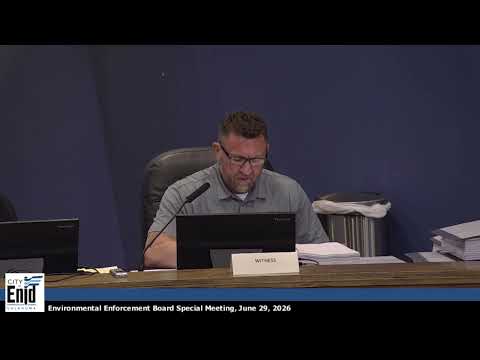
Enid board hears expert dispute over whether Mid Continent discharge caused plant upset and fish kill
Summary
At a multi-day hearing, the City of Enid presented testimony and exhibits tying a May wastewater upset and fish kill to quaternary ammonium compounds (QACs) discharged from Mid Continent Packaging. Mid Continent’s expert disputed causation, saying plant influent QACs were far below literature thresholds and manhole/plant fingerprints did not match.
The Environmental Enforcement Board of the City of Enid heard competing accounts over a May 2025 wastewater plant upset that the city says killed nitrifying bacteria and caused a fish kill in Skeleton Creek. The city presented testimony, invoices and lab reports showing enforcement action (an ODEQ consent order and a $10,000 administrative penalty) and a Department of Fish and Wildlife bill for fish losses. City witness Brooke Brandenburg, Director of Public Utilities for the City of Enid, testified the upset led to response costs for lab testing, emergency chemicals and reseeding the plant.
Mid Continent Packaging called Dr. Kenneth Eade, an environmental chemist, who argued the scientific record does not support the city’s causal claim. Dr. Eade said plant influent totals during the upset—12.59 mg/L on May 20, 6.76 mg/L on May 21 and 11.74 mg/L on May 22—were below the ranges peer‑reviewed studies associate with catastrophic microbial kill and that forensic fingerprinting showed the Mid Continent manhole sample and the plant influent had different QAC profiles. "In my opinion, no, sir," Dr. Eade testified when asked whether the measured influent QAC totals would have killed the nitrifying biomass, and he concluded the manhole fingerprints “did not find their way into the plant inlet.”
City counsel responded that the board’s role is to weigh the totality of circumstantial and direct evidence. Counsel highlighted operational observations—widespread foaming, disinfectant odor at the headworks and at the isolated Mid Continent manhole—timing of a large cleaning at Mid Continent, dye testing that showed the facility’s flow path to the plant and repeated sampling that continued to show elevated QACs associated with the manhole. Counsel urged the board that, under the civil preponderance standard, those facts together make it more probable than not that Mid Continent’s discharges interfered with treatment.
No final determination was announced at the hearing. The board admitted multiple exhibits (including the city’s cost exhibits and Mid Continent’s technical reports), overruled an objection and admitted a side-by-side fingerprint demonstrative. The board set July 8, 2025 as the deadline for post‑hearing written submissions before it schedules an executive session to deliberate.