Get Full Government Meeting Transcripts, Videos, & Alerts Forever!
Get email alerts on the Water Quality topic
No spam. Unsubscribe anytime.
Expert testifies quaternary ammonium compounds likely drove Enid plant upset and fish kill
Summary
An independent wastewater expert testified that repeated, high concentrations of quaternary ammonium compounds (QACs) detected at a Midcontinent manhole and in plant samples were consistent with the May 2025 loss of nitrification at Enid's treatment plant and a reported fish kill, and described the recovery steps the city took.
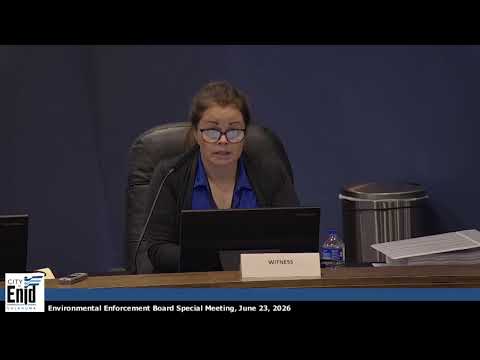
An expert for the city, Dr. Ted Ross Stover, told the board on record that laboratory testing and operational data point to quaternary ammonium compounds, a class of cationic surfactants commonly used in sanitizers and industrial cleaners, as a principal cause of the May 2025 upset at the Enid water reclamation facility. "This indicates to me that the QACs, along with the anionic surfactants as well, were the cause of our upset condition with the QACs being the primary responsibility," Stover testified.
Stover, the Stover Group's environmental engineering witness, walked the board through the plant's daily operating reports and show charts: ammonia, total suspended solids and phosphorus rose sharply after May 19, and visual evidence and photographs show thick foam and a strong cleaning-chemical odor entering the head cells. He said whole-effluent toxicity tests conducted during the upset failed for both indicator species used in the city's permit tests and that DEQ was notified when a fish kill was reported on May 21.
Stover described confirmatory laboratory results from independent analysis that detected multiple QAC family compounds at elevated concentrations in a Midcontinent manhole sample and in plant influent and mixed-liquor samples. He told the board that mixed-liquor testing showed large total concentrations bound to solids and soluble fractions sufficient to reach inhibitory concentrations in the biological reactors. "Seeing those concentrations and those values that are higher than what these credible sources say is enough to affect it," he said, summarizing his interpretive view of the lab data.
On operations, Stover described the city's response to recover biological treatment: short-term use of quaternary-ammonium neutralizers, directed seeding of nitrifying bacteria (purchased from a commercial supplier), and operational ramping of stored wastewater to avoid re-exposure. He said treatment performance began to stabilize in early June after those steps were taken.
Midcontinent and other industrial users were sampled as part of the inquiry; Stover said Midcontinent's manhole samples repeatedly showed higher QAC concentrations than other upstream industrial points, though he and counsel acknowledged complications in exact name-matching and units between different labs. The investigation and testimony left open technical questions about nomenclature and lab comparability that the board flagged for follow-up at the continued hearing.