Get Full Government Meeting Transcripts, Videos, & Alerts Forever!
Get email alerts on the State Legislation topic
No spam. Unsubscribe anytime.
Stuart Little warns fast-moving state "bathroom bill" could burden cities
Summary
At the Roeland Park City Council meeting, legislative adviser Stuart Little said the session is accelerating and highlighted a contentious bathroom bill added onto another measure; Mayor Michael Popa warned the law could impose costly private causes of action and urged residents to contact state legislators.
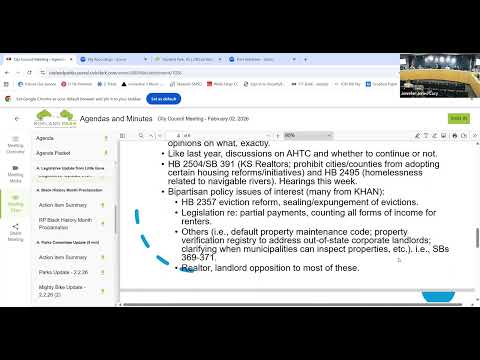
Stuart Little, a legislative relations consultant presenting to the Roeland Park City Council on Feb. 2, told the council the state legislative session is moving faster than usual and flagged several bills that could affect cities.
"The legislative session is moving very quickly," Little told the council, saying budget work and policy bills are advancing on an expedited timetable. He said staff have submitted testimony on multiple measures and that elections- and housing-related bills are also active.
Mayor Michael Popa and council members pressed on one measure in particular. Popa described a bathroom-related provision—identified in the presentation as Senate Bill 244—that was appended to another bill and moved rapidly to the governor. Popa said the provision creates a private cause of action against local governments and could require municipalities to investigate complaints within days. "It puts municipalities, cities, local governments, school districts at significant risk," Popa said, and warned the measure carries steep penalties that he characterized as ranging from $25,000 up to $125,000 per day for violations.
Little said the governor is expected to veto the provision but that an override could be attempted in the legislature given vote margins. Council members discussed building a local record of potential financial impacts and gathering testimony; Little recommended collecting concrete cost and operational information to support municipal testimony if needed.
Council members also raised related topics Little had mentioned, including proposals to move local elections to even-numbered years and proposals limiting local governments' ability to use resources for ballot-question education. The council asked staff to compile talking points and impact estimates to share with members and to encourage residents to contact their state representatives.
Next steps: staff will assemble talking points and any localized cost estimates for council review; the mayor urged residents to reach out to state legislators ahead of potential veto/override activity.