Get Full Government Meeting Transcripts, Videos, & Alerts Forever!
Get email alerts on the Districting topic
No spam. Unsubscribe anytime.
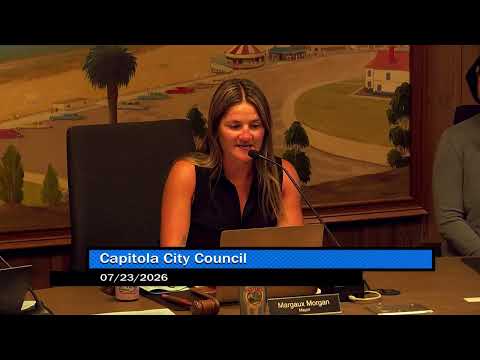
Capitola selects Map 412 for district elections; coin toss sets District 3 seat for 2028
Summary
At its fourth public hearing on July 23, Capitola’s council selected Map 412 for the transition to district elections, discussed sequencing options and used a coin toss to designate District 3 as the seat up in 2028; the council introduced an ordinance for first reading and voted unanimously to proceed.
After a fourth public hearing and extensive outreach, Capitola’s City Council selected Map 412 to include in a draft ordinance converting the city from at‑large to district elections. Staff and the city’s demographer reviewed 12 public map submissions and several demographer options, summarizing statutory criteria—equal population, contiguity and communities of interest—and tradeoffs such as the small split of Turner Lane mobile home residents in some maps.
Council members debated competing maps and neighborhood impacts, then put forward and passed a motion to select Map 412. The council then discussed sequencing (which seats will be on the ballot in 2028 vs. 2030). After deliberation and public comments about keeping small mobile‑home communities intact, the council used a publicly executed coin toss to designate District 3 as the seat to be elected in 2028; the at‑large mayoral election will also be on the 2028 ballot. City attorney and staff then introduced the ordinance for first reading; adoption and second reading are scheduled for the next meeting. All formal votes on the map, sequencing and introduction were unanimous.
City Attorney Mark summarized recent litigation context, saying the court in a related Huntington Beach case “ruled against the city” and required specific remedies, which the city sought to avoid by pursuing the safe‑harbor districting process. Demographer Doug Johnson emphasized the volume of public engagement and the technical challenge of balancing population and neighborhoods in a small jurisdiction.